Davoud Jafari
A research team led by Davoud Jafari at the UT, in collaboration with the University of Pisa, has completed a series of parabolic flight experiments to investigate advanced smart surfaces under rapidly changing gravity conditions. Conducted aboard the Air Zero G aircraft operated by Novespace, the campaign integrated additive manufacturing, boiling heat transfer, and electric-field control into a single experimental platform as part of the #SmartSkin project.
According to Davoud, the motivation behind the campaign was to move beyond simulations and observe how engineered microstructures behave in real, dynamic environments. While the team had extensively designed and modelled their 3D-printed nickel–titanium (NiTi) micropillars on the ground, he explains that “it is one thing to predict behaviour under controlled conditions, and a completely different challenge to see how these systems respond when gravity is constantly changing.” The parabolic flight offered a rare opportunity to expose the structures to alternating phases of microgravity, hypergravity, and normal gravity within seconds.
The micropillars themselves are designed as functional 'smart skins', microstructured surfaces capable of interacting with external stimuli. Davoud highlights that these NiTi-based structures can respond to applied electric fields, opening the possibility of actively controlling fluid behaviour at the surface. During the flight, the team focused on pool boiling experiments, studying how bubbles form, grow, and detach under different gravity levels. "Boiling is strongly influenced by gravity," he notes, "and in microgravity, the absence of buoyancy fundamentally changes how heat is transferred."
A key objective of the study was to understand whether electric fields could compensate for these gravity-dependent effects. By applying controlled electric fields across the micropillar surfaces, the researchers explored new ways to manipulate fluid dynamics and enhance heat transfer performance, even in the absence of natural convection forces. This combination of additive manufacturing, phase-change heat transfer, variable gravity, and electric-field actuation makes the campaign particularly unique.
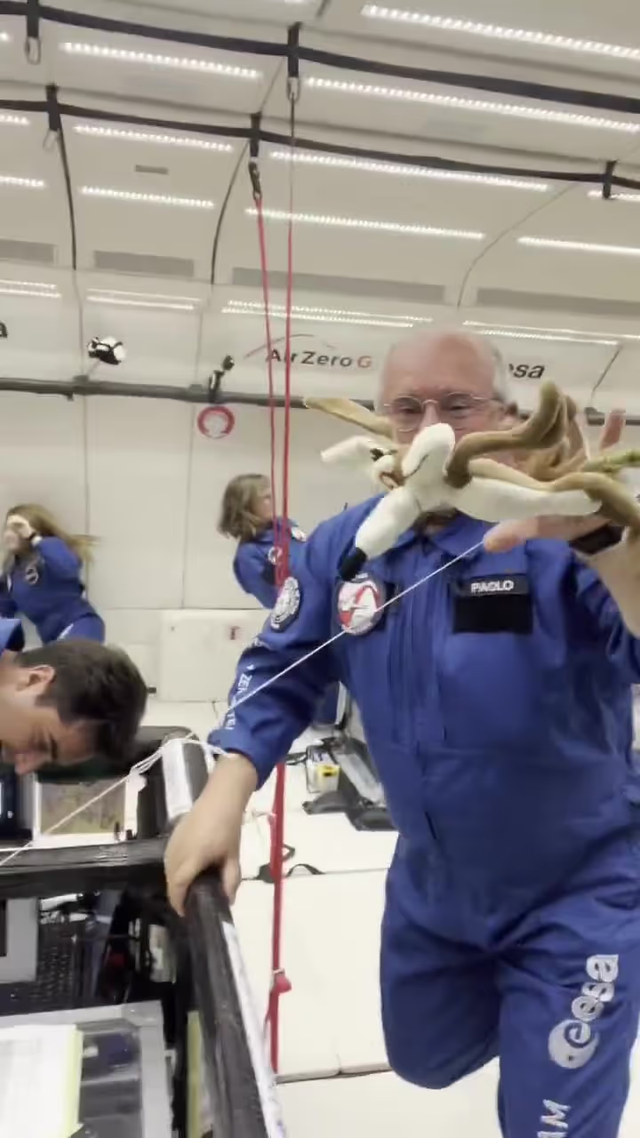
Davoud describes the experimental experience as both technically demanding and deeply memorable. The rapidly changing gravity conditions required precise coordination and timing, as each phase of microgravity lasted only a few seconds. "It was intense, and at times surreal," he reflects. "You are performing high-precision experiments while transitioning between hypergravity and weightlessness, which pushes both the equipment and the team to their limits." He emphasises that the success of the campaign was the result of a strong collaborative effort, describing it as a true #ZeroGravity team achievement.
Beyond the immediate results, the research contributes to a broader effort to develop advanced thermal management technologies for extreme environments. Efficient heat transfer remains a critical challenge in space systems, where traditional gravity-driven mechanisms no longer apply. Jafari notes that smart, responsive surfaces like these could play an important role in future spacecraft, high-performance electronics, and energy systems requiring reliable cooling under unconventional conditions.
The team expressed their appreciation to Novespace for hosting and operating the Air Zero G flight, enabling cutting-edge experimentation in a truly unique research environment.