
Invited review in Chemical Physics Reviews by Dr. Kaijian Zhu, Prof. Guido Mul and Dr. Annemarie Huijser selected as Feature Article
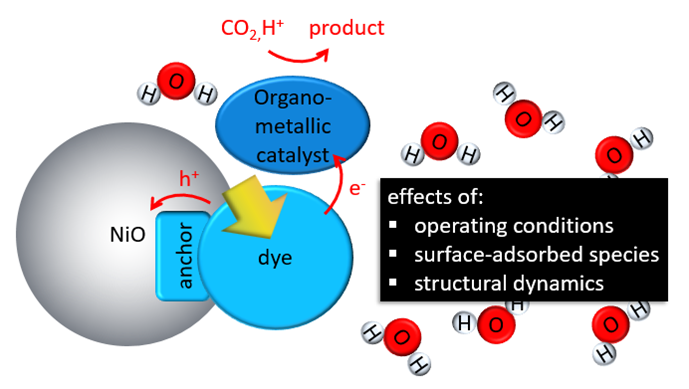
Dye-sensitized photocathodes attract wide interest because of their ease of fabrication and tunability in properties for light-driven proton or CO2 reduction. They are often based on nanocrystalline NiO, functionalized with a photosensitizer and catalyst, immersed into an aqueous electrolyte optionally saturated with CO2. Developing fundamental insight into their photo- and structural dynamics, especially as a function of the nanostructure and process conditions to which the photocathode is exposed, is essential to realize efficient design approaches.
Our work reviews research progress over the last two decades, including the design of an impressive variety in NiO nanostructures, photosensitizers, catalysts, and combined assemblies and the present mechanistic understanding. We highlight the importance of time-resolved spectroscopy studies under operating conditions to associate the early-time photodynamical processes with the overall photocatalytic performance and to understand the effects of surface-adsorbed species on the photodynamics. The nature and concentration of the ions in the electrolyte can play a major role in steering light-induced charge separation and recombination dynamics. We also discuss the importance of developing a better understanding of the interplay between the structural dynamics and the photoinduced charge and proton transfer dynamics to improve the photocathode performance and present several research perspectives.
The article “Dye-sensitized NiO photocathodes: Research progress, current mechanistic understanding, and research perspectives” is available via:


