
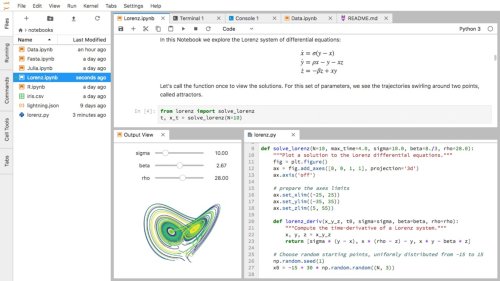
UT researchers and lecturers can now use UT-JupyterLab. This interactive development environment offers you various programming languages, such as Python, and applications such as Matlab and Orange Data Mining. UT-JupyterLab mainly uses the interactive web application Jupyter notebooks. As a UT employee or UT student you can use UT-JupyterLab for free.
A Jupyter notebook is an open-source web application that allows you to integrate your programming code, commentary, multimedia and visualizations into an interactive document. It helps you to quickly gain insight into data. Applications include: cleaning and transforming research data, numerical simulation, statistical modeling, data visualization, machine learning, data mining, and more.
How can you use UT-JupyterLab for your research, teaching or studies?
In UT-JupyterLab you can combine the functions of Jupyter notebooks with applications, such as Matlab and Orange Data Mining. This makes UT-JupyterLab very suitable for:
Exploratory research and prototyping
You can experiment with code and hardware within UT-JupyterLab. You can use hardware (e.g. CPU or GPU) and all kinds of apps and tools - without costs and without having to install them yourself. So you do not have to burden your own notebook or desktop.
Teaching: everyone on the course has the same software and a central data set
For your education you can use a ready-made environment in which all students have access to the same software components and can easily use a central dataset.
Self-study
You can use a wide range of programming languages and applications without having to install them yourself.
Would you like to know more about UT-JupyterLab?
You can find more detailed information about UT-JupyterLab in the Jupyter Wiki and UT Research Support Service Portal.


