Introduction
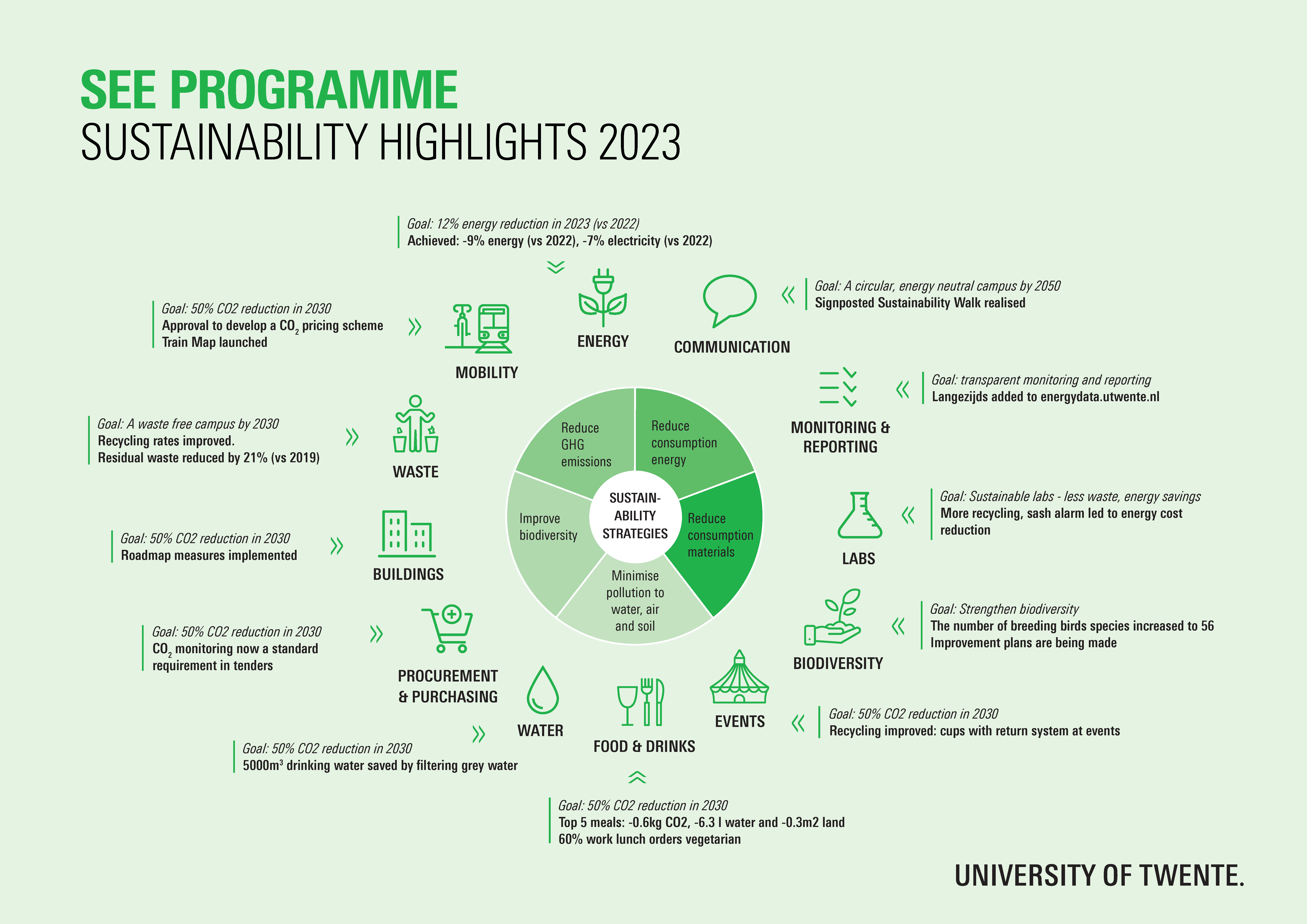
Welcome to the annual report of the SEE programme. On this page, you will find an overview of the actions UT has taken in 2023 to achieve its goal of becoming a sustainable university, split up into various themes. Do you have any questions after reading? Or do you have ideas on how to make our organization more sustainable? Then please contact us through sustainability@utwente.nl!
Overview
The University of Twente wants to be a sustainable organization in 2030. As part of CFM, the SEE Programme was created to achieve this goal in our daily operations. As such, the SEE Programme manages and works on continually and structurally improving UT’s sustainability, energy and environmental performance.
During 2023, the SEE Programme Team has started the transition from the project leader role to a role where enabling colleagues to integrate sustainability in their work to realise a change is the focus. Sustainability initiatives, activities and measures are organized and implemented all over UT resulting in more responsibility in the line organisation for reporting on progress and a more facilitating and supporting role from the SEE Programme Team.
Highlights & links
Energy
Highlights
- Discussions started on ventilation optimisation (day/night settings), a high impact change
- Governmental energy information obligation and energy reduction investigation requirement for UT buildings
- Energy reduction target of -12% set
- Standard winter temperature 19°C, energy savings made
- 100% green electricity
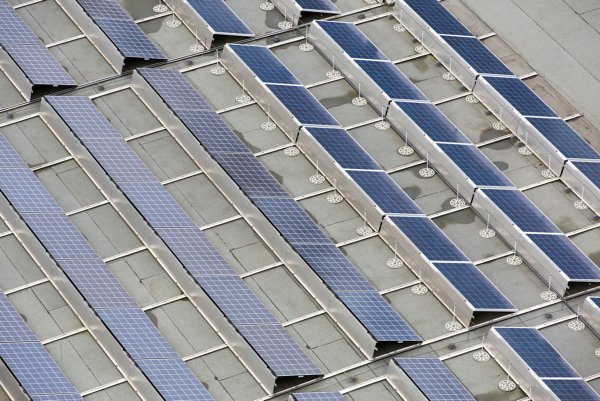
- 1811 solar panels (incl. 916 Langezijds) provide ~1% of UT’s electricity needs
Trias Energetica: Increase efficient use of energy sources. Continue reducing energy consumption by 2% a year. Source all electricity renewably and apply CO2 compensation on remainder of fossil fuel usage from 2022 onwards. Become a carbon neutral campus in 2030. Strive towards a carbon negative campus in 2050.
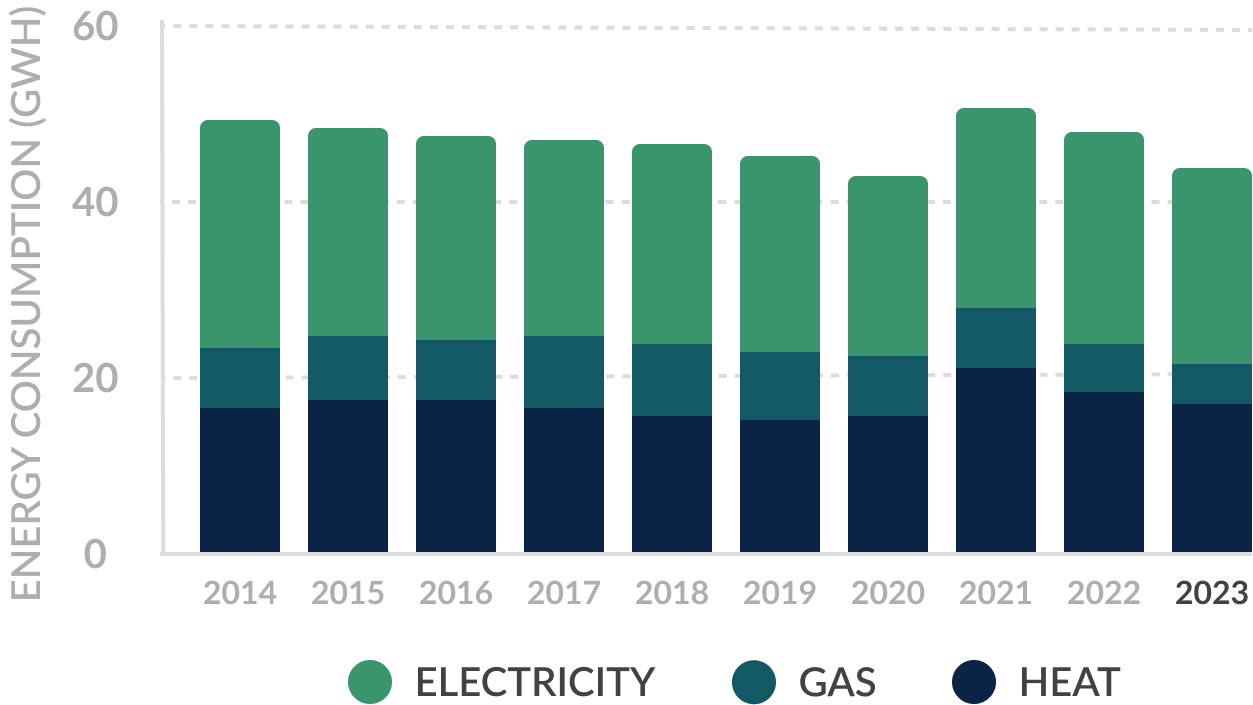
Energy efficiency by reducing energy needs has been the priority in 2023, after increased ventilation demands due to COVID raised UT’s energy use significantly since 2021. One of the measures introduced was lowering the base temperature in all buildings to 19 degrees Celsius.
Stand-by mode
Another example is that all warm drink machines are now on stand-by mode at night, which saves 35kWh per year per machine. Furthermore, by reducing the energy use of unused ethernet ports (UT has over 23.000 such ports) we save 18MW per year, more than 7 times the average annual energy use of a Dutch household. In total, UT used 9% less energy in 2023 than we did in 2022.
Discussions are ongoing about various other measures, for example installing smart climate installations in buildings, installing external sunshades on the Carre building and connecting lighting on the sports facilities to the booking system. Energy consumption in labs is another focal point and will be elaborated on further under ‘labs’
Solar panels
Currently, there are 1811 solar panels on campus. Their electricity production covers around 1% of UT’s annual electricity consumption. The roofs of the Sport Centre, Carré and Nanolab are being inspected for suitability. P4 and Spiegel are possible locations to become solar covered car parks. You can read more about these plans in this article.
Buildings
Highlights
- Roadmap measures for sustainable buildings implemented
- ITC Hotel and faculty disconnected from gas and connected to the heat network
UT's buildings policy goal Existing buildings: Energy Index (kWh/m2/year) 1.3, label C by 2022. Renovations: Shell insulation follows the Dutch building decree for new buildings. New built: BENG, built in energy consumption meters, energy neutral by 2050. Maintenance: A Sustainable Multiple Year Maintenance Plan is operational by 2022 (Sustainable MJOP). Material usage – increased focus on low CO2 impact and circular options.
In 2023 the decision was made to not expand by building new buildings but instead optimise the use of current real estate. Improving existing real estate and making these more sustainable is the focus now. The Long-Term-Housing Strategy (LTSH) programme is committed to make UT real estate sustainable. Every housing initiative (new and renovations to existing buildings) will be aligned to the roadmap to CO2-neutral real estate.
Langezijds
In 2023, the renovation of Langezijds was finalized, improving its energy label from G to A+++. The Vleugel building was fitted with a green roof. More buildings had sustainability improvements done in 2023: Spiegel, Vleugel, Vrijhof, Paviljoen, Meander, Sport centre, Boerderij, Bastille, Boerderij Bosch, Technohal, Erve Holzik, UPark, Hangar, and the Tennis pavilion.
GAS
Compared to 2019 gas consumption has been reduced by 45%. While lowering UT’s CO2 emissions, this is not an actual reduction of total energy needs: many buildings have been transferred to district heating instead. Most notably, the ITC hotel was disconnected from gas and the ITC faculty moved from a gas-heated building to one heated by district heating.
Biodiversity
Highlights
- On World Biodiversity Day, a biodiversity walk was organised where KNNV members guided a group of people across campus while conducting a biodiversity quiz.
UT's biodiversity policy goal Report on the application of biodiversity criteria in all green maintenance decision-making by 2022. Improve biodiversity at two selected sites by 2025.
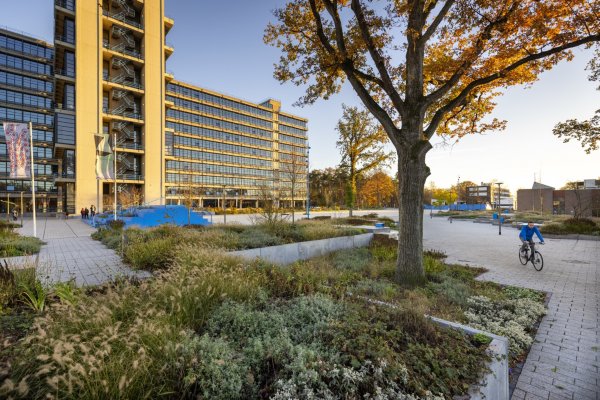
In the daily maintenance of our campus, a lot of consideration is given to strengthening and improving biodiversity. Flower bulbs are followed by wild flowers to increase the availability of nectar and pollen for insects early In the season. Also, more areas are maintained in an extensive manner, where mowing takes place once a year or once every two years.
Biodiversity Plan
In 2023, UT started drafting a Species Management Plan and a Biodiversity Plan to take stock of the current status and make plans on how to improve biodiversity further. Some initial results show that the number of breeding birds increased to 56 species in 2023 (45 in 2009; 51 in 2017). The increase in water birds is likely due to a change in the management of the banks of the ponds resulting in a more natural bank vegetation.
Events
Highlights
- The UT-triathlon organizers (ALOHA) piloted edible pouches to replace disposable cups – waste of 2000 cups avoided
- During the Bata post-consumer waste separation was tested.
- The Bata party worked with a return system to ensure the return of the rPET cups enabling high quality recycling.
- Fifth edition Sustainability Week (UT-Saxion-ROC) was held from 27 November -1 December 2023
UT organised events monitor and report on sustainability performance by 2020 based on criteria compiled by UT. Events organised by external parties monitor and report on sustainability performance based on UT criteria by 2022. First small plastic free by 2021, first large plastic free event by 2022. Waste free events by 2030.
During 2023, the focus regarding events on campus was to minimize the waste they produce. To achieve this, reusable cups or recyclable rPet-softcups with a deposit system were tested and are now the norm at all UT events. At Aloha's UT Triathlon, a pilot (funded by the SEE programme) with sustainable water bubbles that replace plastic cups was succesfully conducted. Tests were also done with post-consumer waste separation at UT events with mixed results: while recycling rates improved, the PMD waste stream was too contaminated with residual waste to be recycled.
Green certificate
The Green Certificate, created by Green Hub, is an immensely successful and highly popular initiative. Its primary objective is to evaluate sustainability measures taken by events through a specialized questionnaire covering Communication, Catering, Energy & Transit Footprint, Materials, and Waste. Student associations implement this checklist right from the start of the event planning process to obtain guidance on how to make their event more sustainable. By doing so, they can avoid future issues and set an example for other events, gaining recognition.
Food & drinks
Highlights
- Green Dish collaboration: caterer Appèl worked together with Green Dish to minimize food waste and to increase the amount of plant-based protein in their dishes.
- All warm drink machines are now in stand-by mode overnight.
UT's food & drinks policy goal Halve the environmental impact (CO2 footprint) of food and drinks served on campus by 2030 compared to 2020. Default option for work lunches is vegetarian in 2020. Every canteen has a meatless day a week by 2022. Impact of food options is visualised in canteens by 2022.
In October 2022, the default vegetarian work lunch was introduced at UT. In 2023, this led to an increase from 33.9% vegetarian lunches to 60.6%, reducing the impact of food on campus.
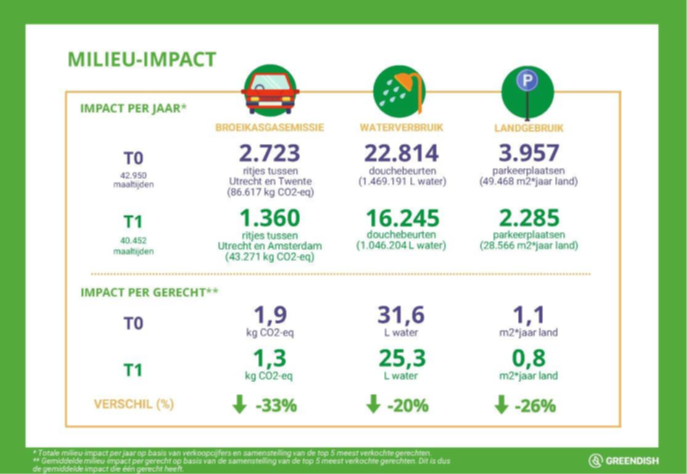
During 2023, employees from our caterer Appèl worked with Green Dish to look into the composition of its meals, with a special focus on the five best-selling dishes. After analysing the environmental impact of these dishes changes were made, with an emphasis on how healthy and tasty the dish is. To reduce the impact the amount of meat was reduced in some dishes and replaced with lentils, improving the nutritional score of the meal, while decreasing the impact.
Lower environmental impact
After analysis and two surveys amongst guests of the Waaier restaurant, the main conclusion is that the climate- and environmental impact of the top-5 dishes in restaurant Waaier on the UT campus has gone down significantly over the past year (see the overview (in Dutch)). At the same time, guest satisfaction has increased. You can read more in this article.
Procurement & purchasing
Highlights
- A workshop “How to apply sustainability in your daily work” was held with the procurement department.
- Four projects started to obtain data on the current performance of sustainable procurement.
- New mission for the Procurement department: “We help you to purchase (socially) sustainably”.
UT's Procurement & purchasing policy goal All new contracts contain a list of UT sustainability criteria by 2022. The weighting of sustainability criteria is increased in 2022 and integrated in the awarding criteria by 2030. Requirements for CO2 monitoring in all new contracts from 2022. KPIs on sustainability in all contracts by 2025. Focus on sharing and service economy options from 2020 onwards. Focus on circular (‘design-for-recycling’), products and services and modular products from 2020 onwards. Increased attention for monitoring compliance by service and product suppliers.
The Procurement department has taken many steps in 2023. The team started by making sure the available knowledge and expertise is present in the team. External and internal training was arranged to build up this knowledge.
Both small and large measures are being taken whenever possible to realize improvements on sustainability and societal responsibility. Procurement criteria in the field of (social) sustainability have been increased and a focal point in all new tenders. Immediate actions to reduce UT’s impact is also taken whenever possible: for example, reducing transport movements and the amount of packaging and stopping the distribution of advertising materials on campus.
A succesful project that was finished in 2023 was the procurement of furniture for the Langezijds building/ITC faculty: buying revitalized and revived products resulted in CO2 emissions savings of 93% (101.8 tonnes CO2) compared to if all new furniture had been purchased.
Travel & mobility
Highlights
- 2nd version Train Map published stimulating train travel over flying in Europe
- A test drive day was organized to encourage the rental of electric and hybrid cars
- Mobility survey 2022 –report almost done; 62.3 % of the employees and 84% of students cycle, both an increase compared to survey 2011.
- Social media Green Hub video Cycle to work-day
UT's travel & mobility policy goal Strong promotion of reduction of travel and sustainable modes of travel. Train is the preferred option for work trips < 800km in 2022. 100% compensation of CO2 emissions from business travel by 2025 and a CO2 neutral campus in 2030 (CO2 negative in 2050). Increase usage of (e-) cycling & public transport. Strive towards a low traffic campus.
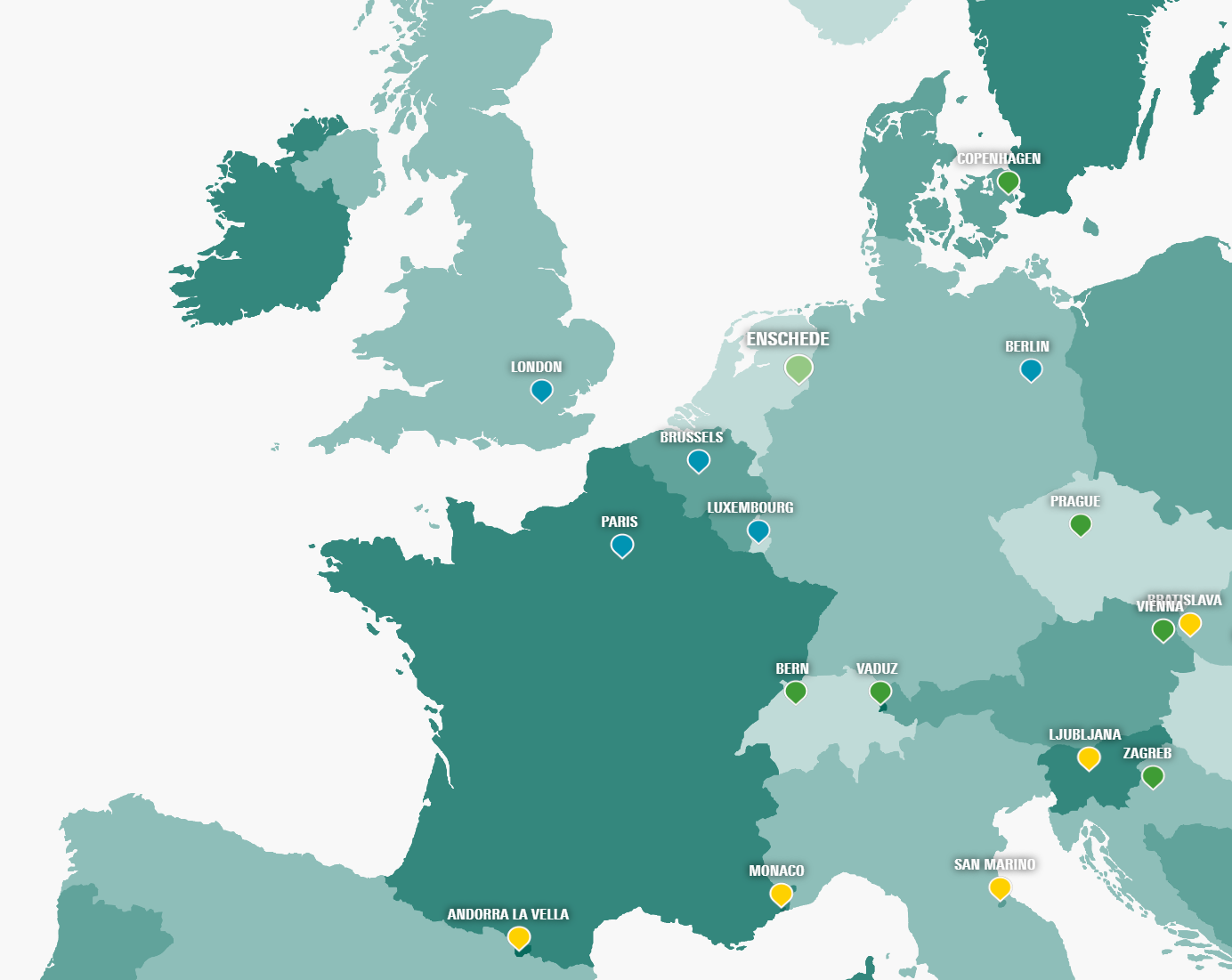
In January 2023, the second version of the Train Map was launched. Through the Train Map, UT wants to encourage its students and staff to take the train to destinations easily reachable by train (below 700km). The discussion on reducing the impact of travelling has led to this map being referred to a lot on social media, such as LinkedIn. The map is not perfect but it stimulated discussion and makes people think about sustainable alternatives to flying.
The CO2 emissions of flights have decreased by 20.8% compared to the baseline year of 2019. Compared to 2022 an increase in CO2 emissions is observed: 18.6% increase in short flights, 2% increase in mid range flights and 24% increase in long distance flights.
Commuting
In 2022, a mobility survey was held among staff and students. Compared to the previous survey on this subject in 2011, the percentage of staff and students cycling to campus has increased: from 53% to 62,3% for staff, and 66% to 84% for students.
Water
Highlights
- A XXL smart rainwater buffer has been realised collecting rainwater from the Sports Centre
- 5000 m3 (about twice the volume of an Olympic-size swimming pool) drinking water saved by filtering grey water.
Reduce water consumption by 5% in 2022 compared to 2020, zero water footprint (water neutral) in 2030. Full recycling of water used on campus in 2050. Trias Aqua: reduce water consumption, use rainwater, reuse water. [einde accordeon]
Several projects were implemented in 2023 to save water. The most impactful of these was the Water Miracle installed in the Waterlab on the Hogekampplein. This purifies ‘grey water’, which can then be used to water the sports fields on campus. This saved 5000m3 drinking water, or 4.3% of the annual water consumption in 2023.
Despite these projects water consumption at UT has gone up by 10% compared to 2022 and 11% compared to our baseline year of 2019. One part of this may be due to leaks: a leaky sprinkler pump has lead to increased water use in Zuidhorst of ~5000m3, another part due to the increased use of water for cleaning mugs now disposable cup are no longer used at UT and the increased need of water for sportsfields due to the dry summer.
Waste
Highlights
- On July 1st, 2023, the UT removed all disposable cups from the hot beverage machines.
- Green Hub and SEE produced a video to show the process of waste recycling from UT waste.
- Green Hub students created poster boards to inform the UT community about what waste stream goes where.
- Business Days stopped using flyers in 2023: 60-70.000 flyers avoided.
A (single use) plastic-free campus by 2022. A waste free campus by 2030. A circular campus by 2050.
The total amount of waste as well as the amount of residual waste has gone down by respectively 17% and 21% compared to 2019. Plastic waste has also decreased, probably because the metal tins and plastic bottles now have a deposit scheme and are thus returned to stores/restaurants by the user. 3000kg of hard plastic, mainly coming from lab waste, has been disposed off separately enabling recycling. The move from the ITC faculty in April 2023 to the campus may have contributed to a lot of paper and residual waste, which leads to the expectation that next year this numbers could go down again.
Removal of single-use cups
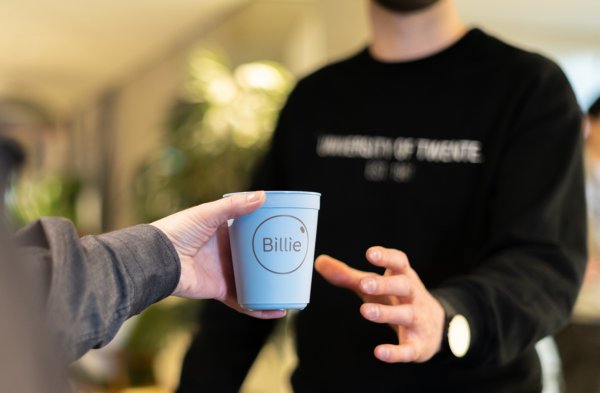
In July 2023, UT removed all disposable cups from the warm drinking machines on campus. Bring your own is the new norm at the UT. This change has been made without complaints, there were only minor practical issues in some buildings. This decreases the amount of waste the UT generates and will prevent a little less than one million disposable cups a year.
New waste processing company
In 2023 the tender for a new waste processing company process was completed, which was announced in february 2024. The new contract has a strong focus on sustainability and collaboration, and will be a partnership between the UT and the waste processing company were we will jointly work to prevent waste, increase awareness and improve waste separation.
E-waste
In 2023, 841 laptops were purchased last year and only 292 laptops were returned for recycling or reuse. UT would like to improve this for data safety reasons as well as for sustainability reasons. It is important to return the resources to the market once the product is no longer in use by handing it in for recycling. In May 2023, ICT department LISA made an action plan with a focus on e-waste.
Various other measures that directly reduce the amount of waste we produce and to raise awareness on what students and staff can do have been taken in 2023. Some examples include:
- Business Days stopped using flyers in 2023: 60-70.000 flyers avoided
- Student association Taste designs their banners and merchandise with a timeless design to prevent the need to replace these annually
- Together with students from the Green Hub, a waste flow diagram and a video about the process of waste recycling were created. These can be found on the Waste page. Green Hub students also created poster boards to inform the UT community about which waste streams should be disposed of in which bin.
- The study associations in Horst now have waste separation bins instead of 1 all-purpose bin. More styrofoam waste bins will be placed throughout the Horst building as well.
Labs
Highlights
- Sustainable Lab coordinator appointed within the faculty S&T
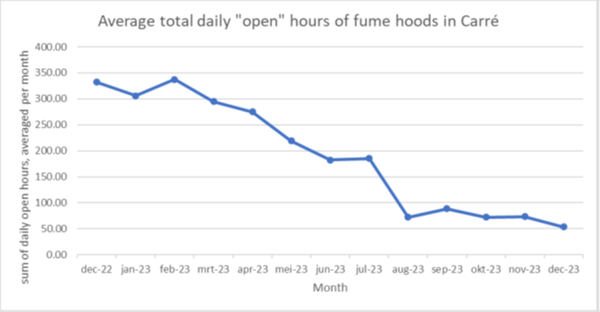
- Substantial progress towards substantial energy savings using day/night settings for labs and good fume hood closing practices, already saved €25.000 in 2023.
- LEAF and MyGreenLabs pilots undertaken to create awareness on sustainability at laboratories
Laboratories are of course essential facilities for our university. However, they have an exceptionally high impact on the environment due to their high energy demand and large amount of poorly recyclable, and potentially hazardous waste output. In April 2023, a dedicated Sustainable Labs Coordinator was appointed at the S&T faculty. Together with lab users, the coordinator takes action to ensure that better, sustainable practices become the norm in laboratories at UT.
Examples include improving waste separation, ensuring that appliances are shut down after use and that fume hood windows are closed after use – both for safety and energy savings (see graph). Other projects include reducing lab ventilation outside of office hours (when safe) and improving the recyclability of purchased products. Already, these projects attract attention from interested parties outside of UT as well.
Contact
Do you have questions about sustainability at the University of Twente? Please contact us by sending an email to sustainability@utwente.nl.