
When two solutions of oppositely charged polymers (polyelectrolytes) are mixed, phase separation occurs leading to the formation of a polymer-rich phase and a supernatant phase. The precise distribution of all components, that is polyelectrolytes and counterions, had not yet been determined. Researchers at the University of Twente can now measure quantitatively exactly where these components are distributed using Nuclear Magnetic Resonance (NMR) spectroscopy.
For over 90 years, chemists have been fascinated by polyelectrolyte complexes which form after solutions of two oppositely charged polymers are mixed. A better understanding of these complexes is crucial for the development of materials based on these complexes. These materials include porous membranes for water filtration, saloplastics that are used as ion exchange membranes, and aqueous-based extraction media.
New method
To improve the applicability of these materials, scientists have developed a method to achieve a better understanding of the complexes. UT PhD student and first author of the paper Giulia Allegri explains: “We introduced a new method based on NMR spectroscopy. It allows us to fully quantify the composition of the system, and measure how all the components are distributed after complexation occurs.” This study marks the first time that all components have been quantitatively determined in both phases.
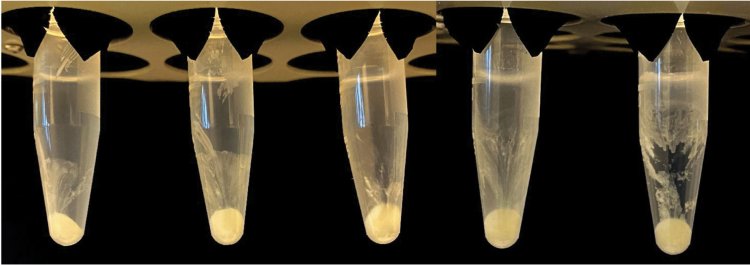
Phase separation: the formation of a polymer-rich phase and a supernatant phase
Furthermore, NMR spectroscopy brings more advantages “The protocol we developed is very fast; we can do a full analysis in less than forty minutes”, says co-author Ricardo Martinho. Allegri adds that this method is label-free and non-invasive. She says: “Polyelectrolyte complexes are very common in nature. We envision that our methodology will contribute to a better understanding of both natural polyelectrolyte complexes and will help to improve polyelectrolyte complex materials.”
More information
Giulia Allegri is a PhD student in the Molecular Nanofabrication research group (Faculty of S&T) supervised by Dr. Saskia Lindhoud. Dr. Ricardo Martinho is a researcher at the Biomolecular Nanotechnology research group (Faculty of S&T). Together with Prof. Dr. Jurriaan Huskens, they published their findings in an article, titled ‘Distribution of polyelectrolytes and counterions upon polyelectrolyte complexation’, in the scientific journal Journal of Colloid and Interface Science. The article is published open access and can be read online.


