
A new harbour or windmill park at sea will continuously undergo the forces of breaking water waves. Those waves have, on their way from the deepest ocean to more shallow coastal waters, undergone lots of changes. PhD student Ruddy Kurnia of the University of Twente developed mathematical models for very fast calculation of the wave behavior, for each water depth and taking into account slopes, quay walls or ships. His HAWASSI software is already available for e.g. harbour designers. Kurnia defends his thesis Friday February 19.
The waves we see at a surface, at full sea or at the coast, consist of numerous other waves at a range of depths. From the deepest ocean waves with a long wave move at high speed, while the waves we see at the surface are short waves moving slower and differ from the deep sea waves in shape and altitude.
Joint action
It is complicated to capture all these changes in mathematical models, therefore often some kind of approximation is chosen. This holds, for example, for dispersion: the relationship between wave length and wave speed. Kurnia does not use an approximation but the exact relationship. He doesn’t choose a numerical approach, that uses strongly simplified equations for a series of times. Instead, he wrote an accurate description of the combined action of the wave at different depths, using the kinetic energy.
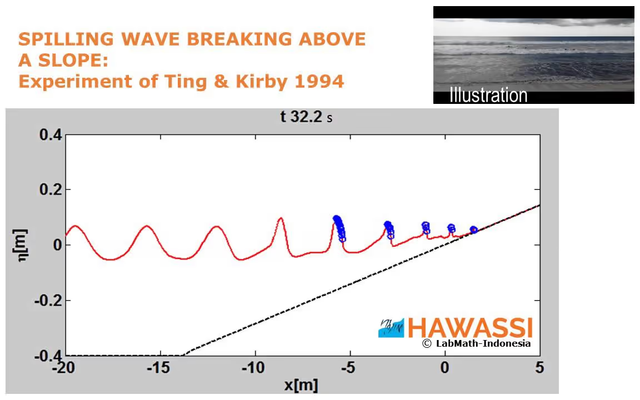
Fast calculation
Thanks to this, the model is applicable for any water depth. Furthermore, Kurnia is capable of introducing abrupt changes: a quay, a sloping coastline, a ship. Despite the added complexity, the models can be calculated very fast – minutes instead of days – by using the so-called Fast Fourier Transform, decomposing any mathematical description in several sinus waves.
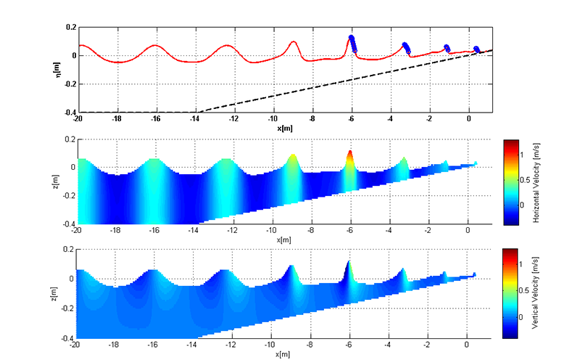
Kurnia’s model calculations have already been compared with the many experiment in ‘wave tanks’ of the Technical University of Delft, MARIN in The Netherlands and the Indonesion Hydrodynamic Laboratory. The models are also very useful to make precalculations of the desired wave in the thank, thus reducing the expensive experimenting hours. Via LabMath Indonesia, Kurnia’s software is available named HAWASSI: Hamiltonian Wave-Ship-Structure Interaction.
Ruddy Kurnia (Bandung, 1987) did his PhD research in de Applied Analysis group (faculty of Electrical Engineering, Mathematics and Computer Science EEMCS). His supervisor is Professor Brenny van Groesen. The research had financial support of the Dutch Technology Foundation STW.
Kurnia will continue working on the models, partly as a postdoc researcher in Twente, partly in his home country Indonesia Kurnia’s PhD thesis ‘HAWASSI-AB, Modelling and simulation of fully dispersive nonlinear waves above bathymetry’ is available as a pdf.
More recent news
 Thu 16 Jul 2026Veni grant for three UT researchers
 Wed 15 Jul 2026Globally unique measurements in Enschede to improve the prediction of urban heat stress
 Tue 14 Jul 2026UT professor Cristian Hesselman contributes to advice on strengthening the resilience of the Netherlands’ telecom and internet infrastructure
 Mon 13 Jul 2026From a Twente idea to a global company: Geert-Jan Bruinsma receives the Van den Kroonenberg Lifetime Achievement Award
 Thu 9 Jul 2026NWO grants awarded to four UT researchers