Recognition and Rewards

Dossier
Links/news
Last edit: 2 Dec 2025

Today's societal challenges call for more collaboration, team science and a multidisciplinary approach by scientists. Putting joint ambitions into practice in Dutch academia requires a more specified Recognising and Rewarding of talent and career paths. With this, the UNL calls for modernisation of the assessment system for talent as a prerequisite and started the national programme Recognition and Rewards; Room for everybody's talent. UT takes it broader and sees it as a part of the Talent Development program, where principles of Recognition and Rewards have to be applied throughout the workflow, starting from recruitment and selection, towards exit practices. The modernisation of Talent Development under the principles of Recognition and Rewards is about more focus on impact-driven work in academia, with the predominance of qualitative assessment over quantitative.

Recognition and rewards: room for everybody’s talent

In the national programme Recognition & Rewards UNL works with all universities, including UT, university medical centres, reputable research institutes and research funders on five main goals:

  1. diversifying and vitalising career paths,
  2. achieving balance between individual and team performance,
  3. stimulating open science
  4. stimulating academic leadership,
  5. focusing on quality, creativity and content instead of quantity

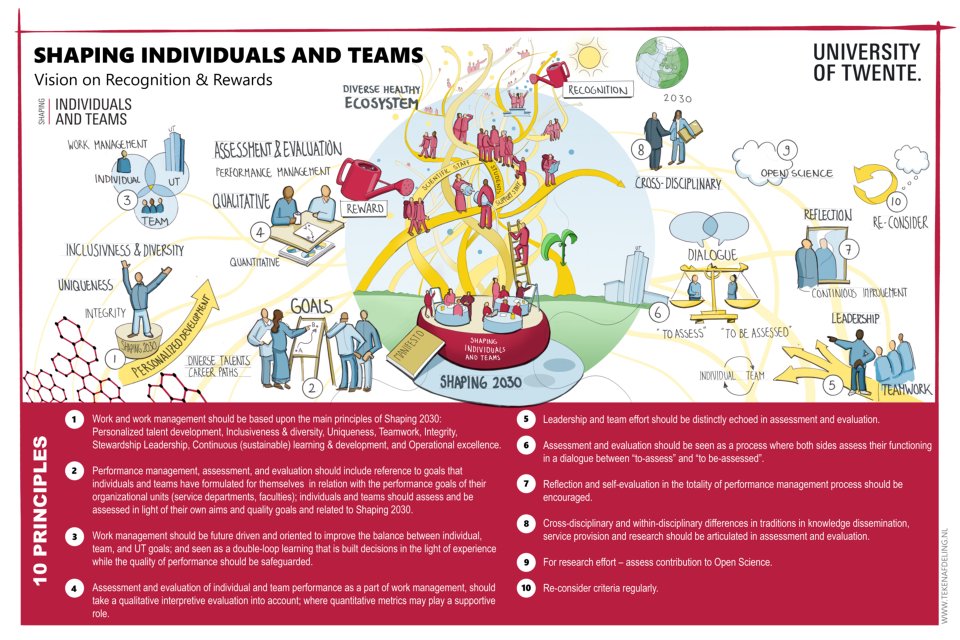
10 UT principles

At UT we go one step further in committing ourselves to rewarding not only academic staff but also supporting staff. In this, we even are a leading example for other universities. The RRteam supports the University of Twente by organising Talkshows, developing concrete tooling and embedding the guiding principles in policies. 
Recognition and Rewards in an international context

On May 16, 2023, the DORA (The San Francisco Declaration On Research Assessment) agreement celebrated its 10th anniversary. The DORA agreement, the "Recognition and Rewards" program, and CoARA (Coalition for Advancing Research Assessment) all pertain to changes in the assessment of academic research and/or education. The summarised relationship between these three initiatives is outlined below. DORA is recognised as the global starting initiative, "Recognition and Rewards" as the Dutch initiative, and CoARA as the European initiative. For further information and background, please refer to the respective websites:

    • DORA is an international initiative aimed at improving the evaluation of research and shifting the focus from quantitative indicators such as impact factors to a more holistic assessment of research output.
    • DORA emphasises the need to assess research based on quality, impact, and relevance, rather than relying solely on journal impact factors or citation counts.
    • It advocates for broader recognition of various contributions to research, including data management, open science initiatives, and collaboration.
    • Position paper: the DORA Agreement.
    • The "Recognition and Rewards" program within a university context reflects the broader principles of DORA by emphasising a more comprehensive and holistic assessment of academic contributions.
    • The program seeks recognition of the diversity of contributions to research, teaching, and service, aiming to promote fair and balanced appreciation of these contributions.
    • Elements of openness and transparency, such as clear communication about the assessment and recognition process and support for open science practices, may also be part of this program.
    • In other European countries, similar initiatives exist with different names.
    • Position paper: room for everyone’s talent
    • CoARA builds on the principles of DORA and emphasises the importance of openness and accountability in the research assessment process.
    • The commitment focuses on making evaluation criteria and processes transparent, as well as minimising perverse incentives that may arise from assessments based solely on quantitative indicators.
    • CoARA encourages institutions to be accountable for their practices related to research assessment and to support open science practices.
    • Position paper:  the CoARA greement.

In summary, DORA, the Recognition and Rewards program, and CoARA collectively create a framework reflecting the shift in the assessment of academic work, emphasizing quality, openness, transparency, and broader recognition of contributions to research and the academic community. They share common values and objectives to promote a more inclusive and equitable evaluation culture.

What can you do to boost your talents? 

As the ultimate people-first university of technology, we invest in your talents and those of your team members. Our aim and approach is to attract, develop and empower everyone’s talent by creating an inspiring, stimulating and inclusive environment. Together with you, we want to make our science and education better, our services healthier, and our careers and opportunities boundaryless. We value having a dialogue with each other, inspiring each other and sharing experiences and successes. But we also work in interdisciplinary groups to combine efforts and create the necessary tools or guide the process to make sure we can make an impact on how someone is recognised and rewarded. Here are some tools that you can use to set your career path. 

  • The Talent Map 3.0 (adopted by the EB in December 2024) is a guide for crafting your career path. It can help you make choices, focus your talents, and reflect on your impact-driven teaching, impact-driven research, academic citizenship behaviour, teamwork, and leadership. 

  • The Annual Interview format and process has been updated in 2025. The new way of working is aligned with Recognition and Rewards values and you might recognise some questions from the Talent Map 3.0. In this process, self-reflection and peer feedback are key. 

    You can find more information on the "annual interview for employees" page.

  • The UT has its own leadership framework to create a shared understanding of leadership and provide clarity on the expectations and responsibilities of leaders in promoting well-being, creating a safe environment and fostering the growth and development of employees and themselves. 

    You can find more information on the "Leadership at UT" page.

  • The UT teaching framework is one of the tools aimed to provide qualitative and in-depth evaluation and recognition of the teaching achievements of all academic staff.

    Important to note is that UFO remains the basis for promotions. The framework offers an additional framework that helps to better interpret the different steps in a teaching career. It thus helps to give 'words' to the different levels of educational performance. Specifically, this teaching framework provides teaching staff practical tools for highlighting their educational achievements in a qualitative interview so that they can take the next career step with an emphasis on teaching.

Get to know: UFO

Your job profile, the level of your position and your salary scale are determined in observance of the rules of the 'University Job Classification' (UFO, Universitair Functie Ordenen in Dutch) system. This system contains job profiles of academic support positions. The differentiating factors coupled with the profiles illustrate the difference in job grade between positions. At the same time this leads to better insight into career paths, both horizontally and vertically.

For more information, refer to the Service Portal.

The Recognition and Rewards programme enriches the basic descriptions in UFO, as mentioned in the Talent Map for instance.

In the spotlight: Teaching Cultures Survey

The Teaching Cultures Survey is a global survey, focused on understanding how the status of teaching and learning is viewed by the academic community. Three cross-section surveys have been undertaken (2019, 2022 and 2025). The surveys were undertaken as a collaboration between the participating institutions and Advancing Teaching, a global initiative focused on improving the recognition and rewarding of university teaching. The results of these surveys yield important information about our own teaching culture and can inspire us in our ongoing efforts to create an environment where education and research are equally valued.

RR Events  

  • Open Science aims to make scientific knowledge openly available, accessible and reusable for everyone, thereby increasing scientific collaboration and the sharing of information for the benefit of science and society. Many of you already contribute to this endeavour; do you feel recognised and rewarded for your efforts?

    This is one of the questions that will be explored at the workshop “How to recognise and reward Open Science in challenging times”, which is part of the OSC-NL National Open Science Week at the UT.

    The workshop is taking place at a relevant time: the UT is currently drafting its Open Science strategy, so the workshop will provide an opportunity to collect input and share best practices, as well as share what is already in place. 

    What can you expect?

    • A brief introduction to Open Science at the UT with Mila Koeva, vice-dean research of ITC
    • A brief introduction to the Recognition and Rewards program at the UT with Tanya Bondarouk, dean of BMS
    • A facilitated discussion on how to support, recognise and establish Open Science as the standard way of working at the UT

    Join us for the workshop on 22 September from 13:30 to 15:30 in TL1133 and contribute to the UT Open Science strategy! All academic and support staff are welcome to join us, regardless of their knowledge of Open Science. We aim to collect various perspectives.

    Registration form

    This workshop is co-organised by the Open Science Community Twente, Strategy and Policy, HR, LISA and the UT Recognition and Rewards program and made possible thanks to NWO funding (Grant number: 500.070.2418).

  • On Tuesday 25 June, some 60 colleagues, from all parts of the organisation gathered in the Learning & Teaching Lab to help think about how the Recognition and Appreciation programme can further shape support staff at UT.

    In tune with the current situation in which the UT is in, this third talk show had a slightly more sober character. However, that did not detract from the good discussions and the rich output on which the RR team, HR and committed colleagues can build further! You can read a first impression of the talk show on our Service Portal.

  • On 25 January 2024 we welcomed about 30 scienitsts at the national interactive theatre performance SCIENCE COMMUNICATION: REWARDED! in the Vrijhof. Together with the actors, they came up with real-life dilemmas and solutions to make science communication a full and recognised part of their daily work.

    Former U-Today columnist Femke Nijboer was asked to attend the interactive performance and write about it. Femke went there with gloomy thoughts, but came out with a sense of hope: ‘Science is a circus. Our circus. Let’s open the doors’. 

    --------

    Circus 

    ‘Science is just an opinion.’
    ‘Scientists say it’s not certain so it’s not true.’
    ‘Scientists are humorless people; they don’t know how to make fun.’
    ‘Scientists say things that everybody already knows, in a language that no one understands.’
    ‘Scientists have a hidden agenda.’
    ‘Scientists live in an ivory tower.’

    In recent years I’ve heard such statements more often in society. I’ve read them in the newspaper, heard them when I saw protests on television, and also heard them right in my face at a birthday party.

    Let’s admit it: science has a bit of an image problem. And not only is it an image problem. It’s worse than that. Society is actually right about some of these things. Scientists can communicate more clearly; science should be more open and – please oh yes please  – scientists should crack more jokes.

    Society is not right about the ivory tower though…. Science to me feels more like a circus! It is a feast of wonder. All kinds of curiosities, rarities and novelties can be seen. All kinds of circus artists create the show. An introvert biologist who can tell you everything about slugs. A jumpy PhD student who will tell you all about her work on cybersecurity. A researcher from the Design Lab who uses Nemo science museum to start a citizen science project. All of these artists together make the show. 

    The University of Twente and organizations like KNAW and NWO know this and want to make the feast more accessible. In recent years, science communication is becoming more important. You need to include a plan for it in your research proposals, you need to do it as a university, you need to show it as a job applicant.

    However, while better communication is greatly appreciated outside the university, communication and public engagement are not always valued within the university.

    The recognition and rewards program of the University of Twente decided to do something about this. They invited a theater maker, Frank Kupper to give an interactive theater workshop on how we can better integrate science communication in our work as scientists. It took place last week and I was invited to do the intro and write a column about what I saw.

    Frank as his crew of actors led us, roughly 30 UT colleagues, through different scenarios and dilemma’s. How to deal with colleagues who think less of you when you engage in non-serious communication, such as going to the Zwarte Cross? How to deal with a department chair who sends flowers when you publish a paper, but not when you write a blog for an online newsletter of a patient organization?

    To be honest, I was pessimistic when the workshop started. Making a career as a scientist feels like having to jump through a lot of hoops. However, we are not all tigers in the circus. Certainly, I am not a tiger. I feel more like a joker or wait – yes - an acrobat who is doing the splits. During the day I do the things that are in the UFO profile (education, research) and at night I do public engagement. With your legs spread - pardon the obscene image that I might instill in your mind- you can’t jump through hoops at all. The circus director shakes his head. I feel like an idiot.

    But by the time the theater workshop ended, I was optimistic. The actors played scenes in which we made it possible. We laughed a lot and were sometimes also deeply moved by sketches. I saw how my UT colleagues in the audience gave very helpful suggestions to the actors. This then changed the ending of the scene. Right in front of us, we saw and rehearsed how we could shape the culture at the university. It left me with hope and renewed love for science. Science a circus. Our circus. Let’s open the doors. 

    Femke Nijboer

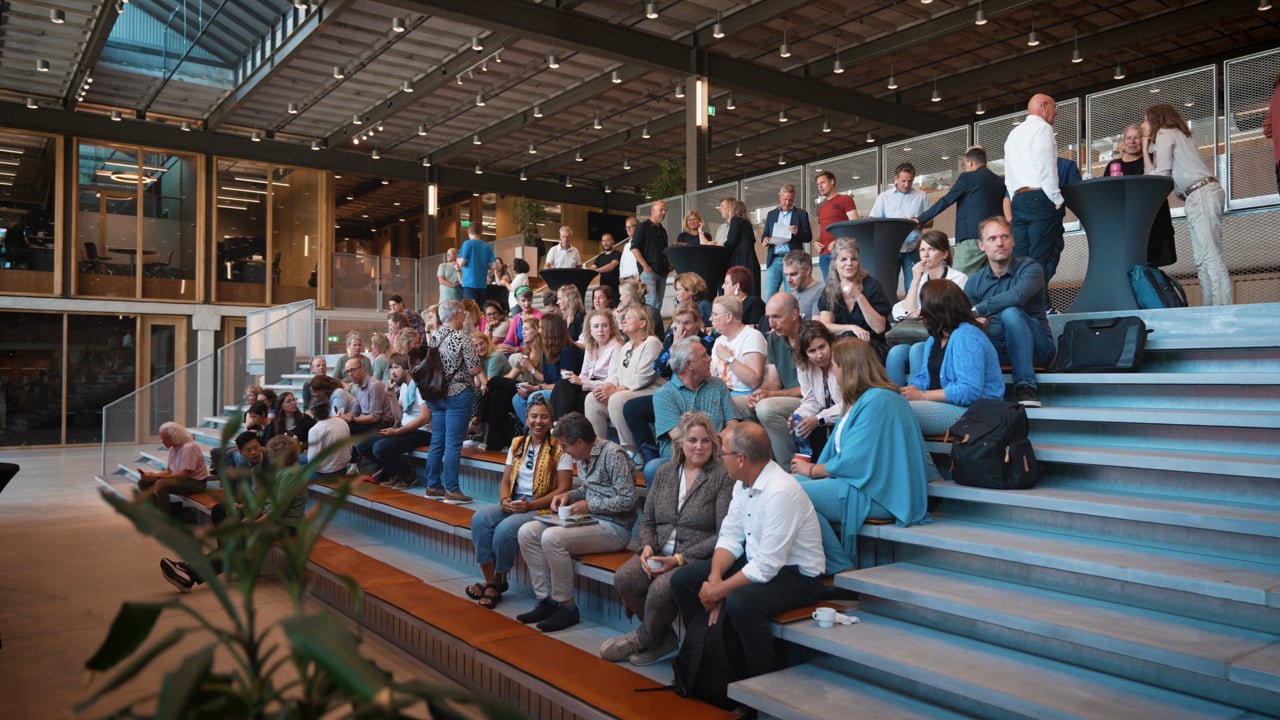
  • On Tuesday 12 September about 80 UT'ers came to Langezijds to speak about Recognition & rewards. Have a look at the aftermovie to get a feel of the afternoon. And make a note in your agenda. The third talk show will take place on June 19.

  • In the first Talk show on Recognition and Rewards (see the aftermovie) students and UT staff were invited to discuss the desired situation and the concrete actions that are needed to bring Recogniotion and Rewards from paper to practice. The event had the form of a 'talk-show'. Led by Roderick van Grieken (the Netherlands Debate Institute), the following propositions were presented:

    1) Assessments should only be done on a team level
    2) The recognition and rewarding method will guarantee a top 10 position for UT by 2030
    3) 20% of free space should be included in all curricula at UT 
    4) Rules and regulations are the biggest obstacles in implementing recognition and rewards
    5) Leadership development is primarily a responsibility of the individual, not the university

    The three bold statements were chosen for in-depth discussion.

    Subsequently, one group was challenged to defend that proposition, another group – argued against it, while the third group was challenged to extract from the discussion the advice for concrete practices at UT. We heard different voices. Roles were rotated, so everyone got a role mentioned above.

    Important takeaways were: Recognition and Rewards is alive, there is space for different opinions, and there is work to be done on how to proceed further. Based on the three chosen statements, it could be concluded that the themes to which the University of Twente should prioritise are known. The most important takeaway is that open discussion contributes to the further development of Recognition and Rewards. That may be stating the obvious, but the absence of a 'contrary voice' would be worrying. The call to repeat the event has been heard. 


Aftermovie second Talk show Recognition and rewards 12 September 2023
Contact

Do you want to know more about Recognition and Rewards or talent development in general at UT? Please contact your HR advisor. 
Do you have any suggestions for the RRteam? Please contact Tom Boogerd.

ir. T.C. Boogerd (Tom)
Policy Advisor Research (BMS) & Program Manager Recognition and Rewards (UT)

Or do you have any improvements or ideas on the broader subject of Talent? Please, contact Annemiek Baars:

drs. A.M. Baars (Annemiek)
HR policy manager
Updates

My favourites

About Favourites
Use the Bookmark this page button on Service Portal pages to add that page to the My Favourites section. To add web applications, use the star icon in the webapplication list. To add pages outside the Service Portal, use the Add custom bookmark button above. Add your favourite apps to your bookmarks by using the favourite button.

The My Organisation section shows mandatory bookmarks for your your main unit.

Please wait a moment...