
Research areas
Tribology (study of friction, wear and lubrication) of contacting interface is by nature highly multidisciplinary. It relates to lifetime and degradation of components requiring knowledge in vastly different areas like system architecture, logistics, data analysis and condition monitoring. Overall, it should be founded on a thorough knowledge about degradation mechanisms that maintenance is aiming to counteract. The main focus on the group is therefore on a scientific understanding of tribological phenomena and degradation mechanisms, mainly mechanisms taking place at surfaces, at interfaces and in contacts.
Tribological mechanisms happening at surfaces are typically highly complex. First of all, due to the fact that these are physical phenomena are taking place at surfaces and interfaces, and therefore are system properties. This means that the related degradation rate is not only dependent on the properties of the degrading component, but also on the environment, external loads as well as a counter body, if present. Further, many degradation mechanisms involve multiple physical domains, for example interacting thermal, mechanical and chemical effects. Also, several competing degradation mechanisms can act simultaneously in a single contact. Based on the knowledge in tribology in terms of friction, adhesion, wear and lubrication, predictive models have been developed. Further, there are well equipped laboratories available to characterize surfaces and validate the models.
The knowledge gained can be applied to predict lifetime and reliability of components and more complex systems. The integration of degradation models with sensors and monitoring techniques is foundational to advanced maintenance strategies. Another application area is accelerated testing. Accelerated testing is so far poorly understood but highly desired. Accelerated testing requires a thorough understanding of both degradation as well as condition monitoring.

Aim:
- Keeping stationary contacts stationary: Bonding, adhesion, hybrid bonds
- Keeping moving contacts moving: Friction, wear, lubrication, degradation
Themes:
- Adhesive bonding / hybrid bonds
- Friction and wear modelling
- Lubricated contacts and systems
- Degradation mechanisms / lifetime prediction

Key focus areas
STATIONARY CONTACTS AND BONDING IN HYBRID STRUCTURAL MATERIALS: DR. J. ZANJANI
Hybridization of materials is defined as the process of combining two or more materials to optimally serve a specific purpose. Hybridization of materials is a potent strategy for creating material systems with properties that do not exist in a single material. Hybridization includes joining similar or dissimilar entities e.g. polymer-polymer, polymer-metal, polymer-ceramic, etc to obtain lightweight, yet reliable, predictable and robust load-carrying structural materials. Hybridization offers many advantages including:
- Right properties at right place

- Weight reduction
- Improved performance
- Higher manufacturability
The performance of hybrid structural materials is largely controlled by the interfaces between their constituents. Therefore, we pay particular attention to the interphases and interfaces between the constituents. Our team develops experimental techniques as well as modelling tools facilitating the interface design for the next generation of advanced lightweight hybrid structural materials. It covers process design, surface pre-treatment, surface characterization, bond performance, and joint design. The group is well versatile in surface pre-treatment techniques and associated surface and interface characterization methods to analyse, describe and optimise the interface formation between various material pairs. The focus is on creating correlations between processing, microstructure, properties, and product performance at the interface to optimise the short and long-term structural performance of hybrid structures. We look for innovative engineering solutions through hybridization and new manufacturing techniques covering:
- Surface pre-treatment (Physical, mechanical, chemical)
- Surface/interface characterizations
- Adhesive bonding, co-bonding, polymer welding
- Additive manufacturing of thermoplastics
- Interface design for polymer-metal hybrids
- Thermoset-thermoplastic interphases
- Wind turbine production and maintenance
- Non-destructive testing/damage assessment
FRICTION AND WEAR of dry, unlubricated and STICK-SLIP INTERFACES: DR. T. MISHRA
Understanding friction and wear in dry, unlubricated or boundary lubricated contact interfaces are critical is mechanical and natural systems. In mechanical systems which require high precision such as precision motion stages, wafer stages and linear bearings in lithography, accurate positioning of these stages requires accurate control of friction particular in stick-slip transitions. Such understanding of friction requires characterisation of friction using high precision tribometers and tribotesting, done using in-house dedicated equipments. Modelling friction during stick slip transition is critical to understanding the degradation in the fibers in high performance industrial ropes. Friction and slip drive the degradation and lifetime of thesefibers which are critical to safety and performance in lifting ropes and textile systems. Studies degradatrion is done using novel in-line, non invasive characterisation.
Additionally wear in such high precision components result in generation of contaminants. These contaminants can severely affect the performance of chips in lithography system. Additionally wear and surface deformation as well as generation of contamination in cold rolling of metals can also affect the lifetime of the work roll in metal forming industry. We develop contact and wear models through experimental understanding to study evolution of surface roughness and particle generation in contacts for components in precision linear bearing and cold rolling and deep drawing. Understanding the friction and wear in these tools for metal forming also include understanding tribological behaviour of metallic coatings.

Studies have shown that earthquake is a frictional (stick-slip) rather than a fracture phenomenon, meaning that frictional instabilities play a crucial role in earthquakes, determining earthquake size and peak slip velocity. Geomechanical models of earthquake slip typically use rate-and-state friction law, but are currently mainly phenomenological, lacking a solid physical foundation in many cases. Within the field of tribology, theories and experimental techniques have been developed for modelling contact and frictional phenomena that can be used to develop better micro-physical friction models that can be used in larger geomechanical models. All in all, there is a clear scientific need to model frictional phenomena in geomechanics. This scientific niche of ‘geotribology’, at the boundary of geomechanics and tribology, is almost unexplored and provides an opportunity in this societal relevant topic. Apart from earthquake dynamics, the subsurface of the earth is getting more and more important in the current period of geothermal energy extraction and CO2 storage as well as the realization of renewable energy sources. Friction and cohesion parameters in compaction of granular materials such as soil are crucial to construction of earth structures, for e.g. embankments, retaining walls etc. In this regard we develop circular geopolymeric contruction materials using dredge as well as high performance geopolymer coatings.
PHYSICS-BASED DEGRADATION MODELING AND PREDICTION: DR. J. A. OSARA
All things degrade. In many engineering systems, failure can be fatal and prohibitively expensive. For example, according to published news reports, bearing seizures have led to catastrophic failures of complex systems, e.g., helicopters, trains, etc. Typically, a grease-lubricated bearing would fail when the grease in it has degraded and lost its lubricity. Hence, the need to understand and predict grease degradation (or remaining useful life) cannot be over-emphasized. Optimum preventive maintenance of engineering systems requires accurate degradation modeling and prediction. Recent advances in irreversible thermodynamics have shown high accuracies in degradation modeling. Here, our research focuses on further developing the field of “degradation thermodynamics”—an adaptation of irreversible thermodynamics to degradation mechanisms—for modeling grease-in-bearing and solid interfacial degradation.
The first and second laws of thermodynamics, respectively, govern a system’s energy exchanges and losses during the system’s operation. In degradation thermodynamics, these laws are combined and adapted to describe the transformation of a system’s available useful energy (or free energy), the loss of which correlates with the system’s degradation.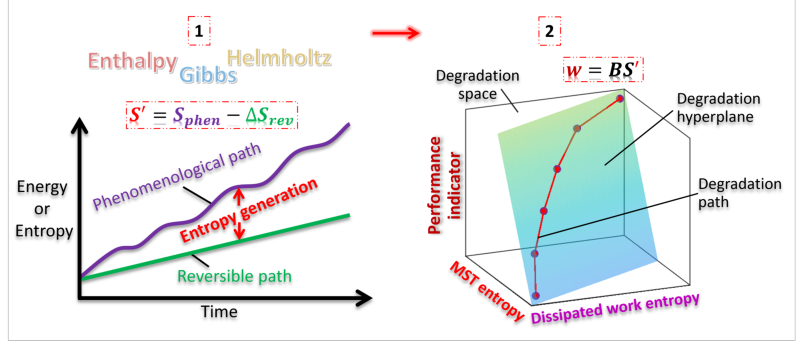
Most energy exchanges/interactions in tribological systems involve the primary load (or work) mechanism accompanied by energy dissipation via heat and microstructural/configurational changes. While the magnitude of the primary contact load mechanism is easily determined via the process variables, such as forces and velocities, the accompanying microstructuro-thermal (MST) energy dissipation, contributing significantly to degradation, is much more difficult to evaluate. It has been shown that MST energy dissipation is a function of the system’s entropy content which, in turn, is a function of material properties, process variables and instantaneous temperature. In our research, we use the above fundamental concept to identify, understand and characterize degradation mechanisms in variegated tribological systems including surfaces, dry and lubricated contacts, and bearing grease.
LUBRICATED CONTACTS. Friction, Wear, System Behaviour: DR. N. BADER
Lubrication is used to reduce friction and wear in interfaces of technical systems. The aim is to separate the surfaces through a lubricant film, thus lowering friction, reducing wear, and controlling temperature. The rheological properties of the lubricant govern both the lubricant film thickness and the traction (friction). Additives can be added to change the rheological behaviour, the life of the lubricant, and to modify the interface. Physical and chemical interactions between lubricant and interface can change the tribological system.
To accurately predict both life and losses during operation, models are used. Our aim is to model the interacting surfaces of tribological systems including the lubricant behaviour. Through a physical understanding of lubricant rheology, lubricant-surface interactions, surface topography, and bulk properties the complete behaviour and degradation can be taken into account. This enables predictions of losses and life of technical systems.
The technical systems We focus on include rolling element bearings, dynamic seals, cam follower contacts, and skin pass rolling.
Projects linked to lubricated contacts: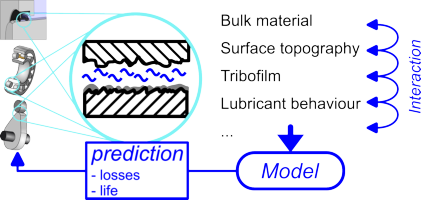
· Degradation of Stern Tube Seals
· Friction and wear in cam-follower
· Friction in rolling element bearings
· Life of backup rollers