
Rubrics
When, for an assignment or task, the expectations are vague and not explicit, it is harder for students to work on it in a targeted way and to know when they will be successful. At the same time, it will be harder for the teacher to assess the work well. The feedback process might become a frustrating experience for both parties: the teacher/assessor and the student. This is surely not what we want.
Feedback is a powerful tool to enhance the learning process, but only if the feedback is related to the learning goals, if it is specific, clear, and actionable.
Rubrics can play an important role in providing effective feedback and, at the same time, in justifying the grade. Rubrics communicate quality expectations for an assignment or task and help evaluate the quality of the result of this assignment or task.
Rubrics are based on evaluative criteria, standards, quality definitions, and a scoring strategy. This is just a very succinct description. To get a better idea, the following video provides a nice overview: Creating Effective Rubrics (8.29 min.) by CTL at UofA.
More benefits of rubrics
- Rubrics help you to make your expectations (more) explicit and articulate them. It ensures that you emphasize what you want to see in the performance.
- Rubrics help you stay focused and consistent when assessing the work or performance of students and therefore make the assessment more reliable. If different assessors are involved in assessing the work of all the students, rubrics help to ensure a high(er) degree of inter-rater reliability.
- Rubrics can be used as an instrument, a format, for efficiently providing feedback.
- Rubrics can be used in a formative way (without grading, but supporting the learning process) and a summative way (to assess and grade the final
deliverable or performance) and in the same course, for both purposes (e.g. first students get feedback based on the rubric on their drafts. In the end, the same rubric is used to assess their final paper.). - Rubrics can be used as instruments for peer feedback and self-assessment.
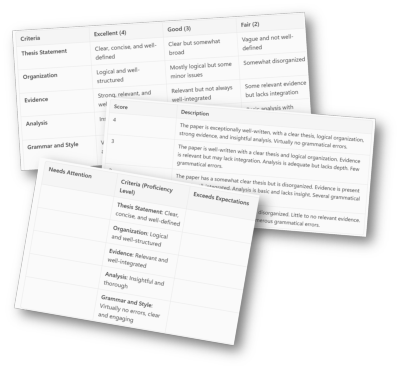
Different kinds of rubrics
Three kinds of rubrics can be distinguished: the analytic rubric, the holistic rubric, and the single-point rubric.
For a nice overview of these 3 kinds of rubrics, see: Rubric Best Practices, Examples, and Templates – Teaching Resources.
As a teacher, you can create your own rubrics (teacher-generated). To ensure that rubrics support students in their learning and work process, it is recommended to share and discuss the rubric with your students at the start of their activities. But rubrics can also be generated by the students (with some guidance from you as the teacher) or can be created in cooperation. The more students are involved in the process, the better they will understand the criteria and standards for evaluation.
Further reading:
On the internet, you will find a lot of information about rubrics and especially many examples you can use if you want to build your rubric.
To read more about rubrics, see the next links, but if you Google, you will find many more.
- Holistic, Single-point, and Analytic Rubrics, Oh My! Nice brief overview of the different types of rubrics.
- DCU Guide to Assessment (PDF) - Nice guide with many useful phrases to use when creating a rubric
- How to Design Effective Rubrics (Center for Transformative Teaching, Nebraska) A nice explanation about rubrics, which also explains the benefits.
- Microsoft Word - How_to_Create_Rubrics.doc (uaf.edu) An instructive description to help you create a rubric. Showing different types of rubrics.
- Grading and Performance Rubrics. Explanation and some very nice examples from Eberly Center.
- More Examples of Rubrics and Other Resources (DePaul University Teaching Commons) Examples of rubrics for specific purposes, such as class participation, teamwork, multidisciplinary work, research papers, and more. DePaul University Teaching Commons.
- Create an interactive PDF rubric - YouTube (19 min.) Quite sophisticated. How to make a PDF form that you can use multiple times and that will easily calculate the scores.
Rubric examples
- AAC&U Rubrics (in one document) or VALUE Rubrics (online). For inspiration: A lot of exemplary rubrics for complex skills such as critical thinking, ethical reasoning, information literacy, and more.
- Overview of all kinds of rubrics Examples of Rubrics - IE – Syracuse University
- Two example rubrics for Math: cp rubric.pdf / Rubric For Grading Proofs
- Research Paper Rubric.xls Rubric for Research paper
- Matrix with assessment rubrics_for interdisciplinary skills.pdf
- Rubric Packet PDF (Chicago State University - CTRE). Elaborate list of rubrics for different skills and domains in different varieties.
- Sample Rubrics | Academic Assessment | Utah Tech University. Several examples, e.g., group participation, design project, and integrative learning.
Make a rubric in Canvas
- Information about Canvas for UT staff can be found here: Canvas (login & documentation for lecturers) | Service Portal | University of Twente
- Using Rubrics: Canvas 101. With instructional video.