
Gender-neutral language is preferred wherever possible.
In practice, gender-neutral drafting means three things:
- the general use of using nouns and pronouns that are clearly gender-neutral;
- avoiding nouns that appear to assume that a man rather than a woman will perform a particular role: ‘chairman’ is the most obvious example;
- avoiding gender-specific pronouns for people who have not indicated their gender.
Noun forms
Gender-neutral noun forms (chair, spokesperson, etc.) are preferred:
- EXAMPLES: firefighters instead of firemen; police officer instead of policeman or policewoman; tradesperson and craftsperson instead of tradesman and craftsman
Pronouns: they, them and their
The gender-neutral pronouns that are to be used are they, them and their, both referring to singular and plural nouns:
- EXAMPLE: This does not apply when a passenger misses a connecting flight for which they have a reservation.
- EXAMPLE: Identify the person responsible and take their advice.
- EXAMPLES: The Director of Education voiced their concerns: they said that the topic needed further discussion.
- AVOID: The Vice-Chancellor of the University must use his discretion.
The use of a third-person plural pronoun referring to a singular noun was formerly perceived as grammatically incorrect, but is now widely used.
If the text clearly refers to a specific individual on a particular occasion, and you know the gender of the person concerned, you may use a gender-specific pronoun:
- EXAMPLES: The High Representative (Baroness Ashton) voiced her objections.
- EXAMPLES: The President of the Commission (Mr Delors) said that he welcomed the common position reached at the Council.
Otherwise, depending on the circumstances, consider the following FOUR alternatives:
1. When writing instructions, use the second person or the imperative:
- EXAMPLE: You should first turn on your computer.
- EXAMPLE: First turn on your computer.
- AVOID: The user should first turn on his/her computer.
Where possible draft in the plural; this is very common in English for general references:
- EXAMPLE: Researchers must be objective about their findings.
- EXAMPLE: This does not apply when passengers miss connecting flights for which they have reservations.
2. Omit the pronoun altogether:
- EXAMPLE: The chair expressed dissent.
- AVOID: The chair expressed his/her/its dissent.
Substitute ‘the’ or ‘that’ for the possessive pronoun:
- EXAMPLE: A member of the Court of Auditors may be deprived of the right to a pension.
- AVOID: A Member of the Court of Auditors may be deprived of his right to a pension.
3. Avoid using ‘he or she’; use 'they' if possible:
- EXAMPLE: This does not apply when a passenger misses a connecting flight for which they have a reservation.
- AVOID: This does not apply when a passenger misses a connecting flight for which he or she has a reservation.
Using 'he or she' becomes clumsy if repeated too frequently and should be avoided. If its use is really necessary, prefer ‘he or she’ to ‘he/she’, ‘(s)he’ or ‘s/he’, which should be avoided.
4. Repeat the noun:
- EXAMPLE: This does not apply when a passenger misses a connecting flight for which that passenger has a reservation.
This can be cumbersome and look excessively formal, but may be a useful technique in a longer sentence.
tool: ms word check for gender-neutrality
Microsoft Word has a nifty tool that can help you check a document for inclusiveness and gender-neutrality. What you need to do is: open your document - select File - select More - select Options - select Proofing - go to Writing Style, there find Grammar & Refinements and click the button for Settings. You will see a list of subjects with boxes you can tick. Go to the section named 'Inclusiveness', tick all boxes and then click 'OK' at the bottom:
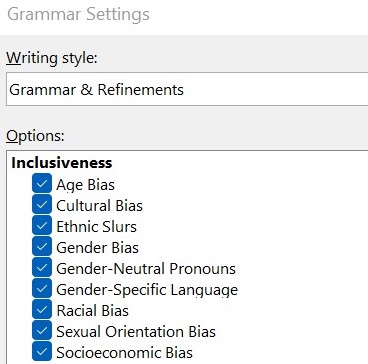
MS Word will now start checking your documents for inclusiveness. When a word is found to infringe on one of these categories, it will be underlined and a list of suggested alternatives will be provided, e.g. MS Word will suggest changing a word such as manpower into workforce.
Reference List
European Commission English Style Guide - A handbook for authors and translators in the European Commission Eighth edition: January 2016. Last updated: July 2023 "[PDF File]" https://commission.europa.eu/system/files/2023-07/styleguide_english_dgt_en.pdf