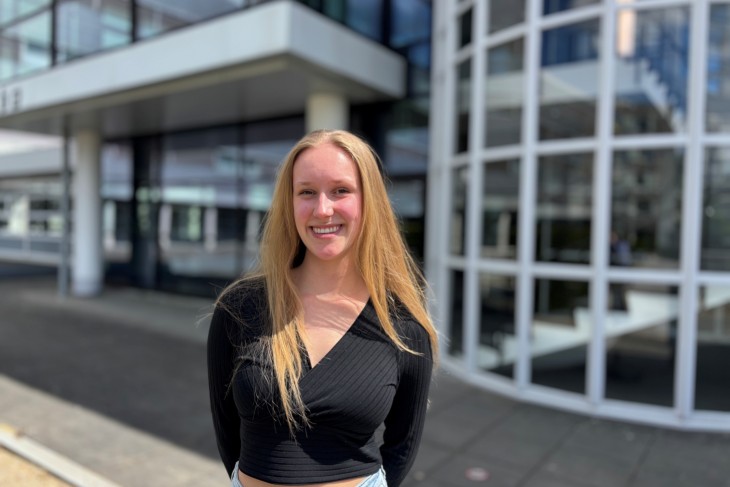
“My background is in marine biology, and I used to work in environmental conservation in Canada. But I wanted to understand sustainability from a corporate side—how can companies change operations to reduce their footprint while still making a profit?
I wanted to go to a country I hadn’t been before. When I came across the Master’s in Environmental & Energy Management at the University of Twente, it piqued my interest. Moving from Canada to the Netherlands was exciting!
Case project
What I like about the study programme is that it offers three specialisations: Water, Energy, and Environmental Management. I wanted to learn about corporate social responsibility—how companies can become more socially and environmentally accountable—so I chose the specialisation in Environmental Management.
The highlight of the programme was working on a case project, where we conducted research for Circular Friesland, an association leading the transition to a more circular economy in Friesland. Currently, they use cement and similar materials for building construction. My team researched more sustainable and circular materials and helped them understand the barriers and opportunities for their adoption from a managerial perspective. We did market research, stakeholder analysis, and cost assessments, and presented our findings. It was valuable because we experienced what it would be like to work at a similar organisation!
Hands-on learning
My thesis was another exciting but also challenging project. I wanted to research alternative fuels for the EU shipping sector—analysing how different fuel options could help reduce emissions under EU policies. People often say, "Just switch to greener energy," but it isn’t that simple. For example, if the EU decides to use green ammonia for shipping, what happens when ships travel to regions without ammonia refuelling stations? That’s a huge problem.
Through my research, I learned something very important—real change requires governments, scientific institutes, businesses, and nonprofits to work together. Nothing happens in isolation.
In the heart of circular economy
Classes take place in Leeuwarden, located in the province of Friesland. It's famous for its innovations in circularity, and it’s packed with companies and research institutes working towards a circular economy.
Besides, Leeuwarden is a great place to live! It's a peaceful city with beautiful canals, plenty of cultural activities, scenic bike routes, and a lively city centre. And Groningen, famous for its dynamic student life, is just a half-hour away. The best part is that there are other universities and colleges as well, so you meet students from different backgrounds.
Career in sustainability
Since graduating, I have been working at SeaO2, a Dutch startup that captures carbon dioxide (CO₂) from the surface of seawater to fight climate change. The captured CO₂ is either stored permanently or converted into concrete or green fuels. As a Founder’s Associate, I work on business development—connecting with companies that want to buy carbon credits or invest in green fuels made from captured CO2 instead of fossil fuel-based CO2.
“This Master’s taught me to understand and work with people in different roles and adopt more sustainable practices together. This is exactly what I’m doing in my job, and I’m grateful for everything I’ve learned.”