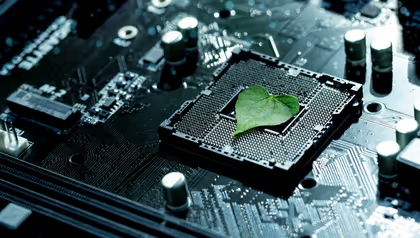
 A new route to optimise AI hardwareA team led by the BRAINS Center for Brain-Inspired Computing at the University of Twente has demonstrated a new way to make electronic materials adapt in a manner comparable to machine learning. Their study, which appeared in Nature Communications, introduces a method for physical learning that does not require software algorithms such as backpropagation. Backpropagation – the optimisation method popularised in the 1980s by Nobel Prize winner Geoffrey Hinton and colleagues – is at the heart of today’s AI revolution.Read more
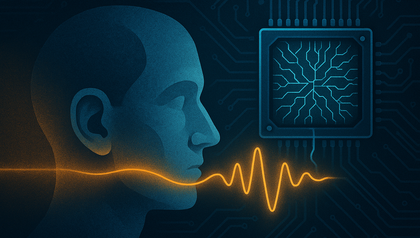 Material that listens: Twente breakthrough in speech recognitionSpeech recognition without heavy software or energy-hungry processors: researchers at the University of Twente, together with IBM Research Europe and Toyota Motor Europe, present a completely new approach. Their chips allow the material itself to ‘listen’. The publication by Prof. Wilfred van der Wiel and colleagues appears today in the prestigious scientific journal Nature. In the last five years, a UT scientist has been a lead author in Nature twice.Read more
 A new route to optimise AI hardware
 Material that listens: Twente breakthrough in speech recognition
 Can the brain help us fix AI's energy problem?
 Two Brains Centre projects receive NWO KIC funding
 Een computer op je hersenen geïnspireerd. Is dat de toekomst?
 Neuromorphic Computing
 Nobelprijzen voor natuurkunde, chemie en geneeskunde
 Our tech is a huge energy guzzler, here's how we're changing it
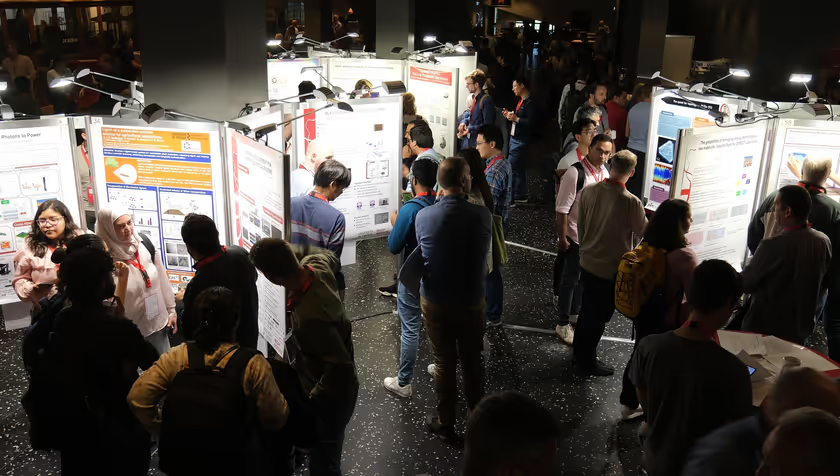
 BRAINS Day 7th of October 2024
 Researchers develop new method for molecular computing
 Throwback succesfull MESA+ Meeting 2024
 BRAINS Day - October 7, 2024