Predictive Plan - Predictive Workload-Aware Feature-Based Planning for Resilient High-Mix Low-Volume Manufacturing
The project Predictive Workload-Aware Feature-Based Planning for Resilient High-Mix Low-Volume Manufacturing (PREDICTIVE PLAN), is a strategic initiative within the High Tech Systems and Materials (HTSM) program, specifically focused on Systems Engineering for High Tech Systems.
The primary objective of PREDICTIVE PLAN is to develop and validate a predictive, feature-based, and human-centric planning framework designed to manage variability early and throughout the production process. It aims to provide explainable, data-driven digital assistance to planners and engineers by combining artificial intelligence, simulation, and human expertise to enhance the sustainability, resilience, and efficiency of Dutch high-tech manufacturing.
The project addresses the critical challenges faced by High-Mix, Low-Volume (HMLV) manufacturers like Thales NL. Current planning systems (ERP/APS) are designed for standardized products and fail to account for high Variability due to unique products and complex routings lead to unpredictable bottlenecks and resource conflicts, human capital risk, planning heavily relies on the "best-guess" estimations of experienced planners who are nearing retirement, making the function vulnerable and unsustainable
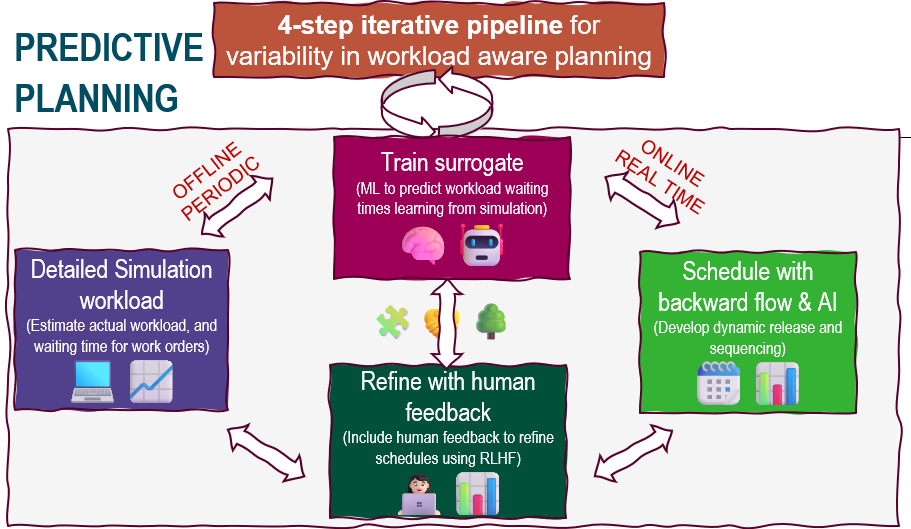
Predictive Plan follows a 4-Step modular research cycle to move from proof-of-concept to industrial implementation. Including Digital Twin (Module 1): Building a discrete-event simulation to model demand, supply, and operational variability, AI Surrogate Models (Module 2): Developing machine learning models for near-instant predictions of workload, waiting times, and throughput, Hybrid AI Planning (Module 3): Integrating surrogate predictions with reinforcement learning and heuristics to optimize job release and material planning, Human-in-the-Loop (Module 4): Implementing a framework that uses Reinforcement Learning from Human Feedback (RLHF) to capture tacit knowledge and ensure planners trust and adopt the system
The project targets reaching a Technology Readiness Level of 7 (TRL7) with a validated prototype operating in "shadow mode" at Thales, Key performance targets include: 40–50% reduction in waiting times and work-in-progress (WIP), 10–15% reduction in material waste and energy consumption, increased on-time delivery and faster, more consistent planning decisions and digital Intelligence for human workers: Capturing the expertise of retiring planners to support younger staff with explainable AI.