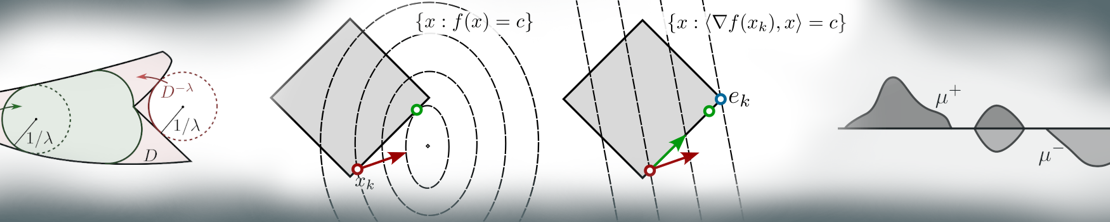
Recent advances in inverse problems and machine learning have heavily relied on the application of novel variational and geometric methods. These methods provide a robust framework for solving complex optimization problems, enabling researchers and practitioners to recover information from noisy and incomplete data, develop accurate prediction models, and extract meaningful insights from large datasets.
Sparse optimization, geometric deep learning, variational inference, and optimal transport are just a few examples of the variational and geometric techniques that have contributed to the development of the new generation of inverse problems and deep learning models. Our research aims to delve into the theoretical questions that motivate the use of these methods, while leveraging the resulting insights to create novel techniques and broaden their application to real-world problems.
People