
Researchers from HealthTech Nexus, a collaboration between the University of Twente and Radboud University Medical Centre, are investigating whether artificial intelligence (AI) can learn something that experienced surgeons often do instinctively: estimate tissue tension during surgery. If successful, AI could help surgeons further improve their surgical techniques and potentially reduce complications.
Many surgical procedures are performed using laparoscopic or robotic instruments. These procedures are routinely recorded on video. Surgical videos play an important role in the training and assessment of surgeons, but analysing them is time-consuming.
‘An experienced surgeon spends approximately 45 minutes reviewing a surgical video,’ says Dr Frans van Workum, gastrointestinal surgeon at the Radboud University Medical Centre and Canisius Wilhelmina Hospital. ‘At the same time, more than 100,000 hours of surgical video footage are generated every year in the Netherlands.’
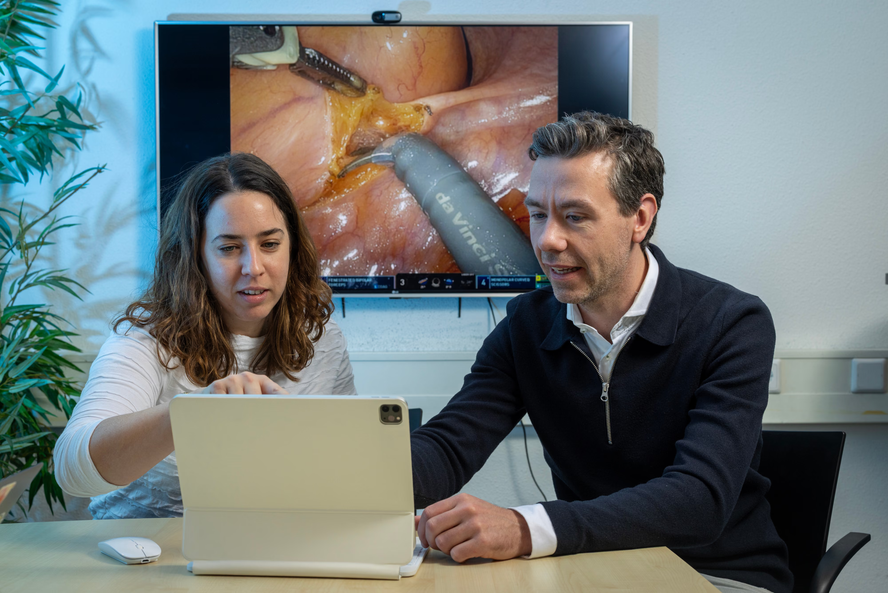
AI systems can already analyse various aspects of surgical procedures, such as the duration of specific surgical steps, the number of unnecessary instrument movements, and the amount of blood loss. The assessments made by these systems often closely match those of experienced surgeons.
However, one crucial element is still missing: estimating tissue tension. During surgery, surgeons stretch and separate tissue to perform precise dissections. Correctly assessing the tension applied to tissue is essential for preventing damage to surrounding structures.
‘When we separate two pieces of tissue, we often work at the point where the tension is greatest,’ says Van Workum. ‘Learning to feel that tension is a skill surgeons acquire only after years of experience. Computers cannot currently perceive it, but we want to investigate whether they can learn to recognise it.’
The study focuses on whether AI models can infer tissue tension from surgical video footage. The models will analyse factors such as the extent to which tissue is stretched, which instruments are being used, and how those instruments move during different stages of a procedure.
‘We are going to train algorithms to recognise visual patterns in surgical videos,’ says Dr Estefanía Talavera Martínez, Assistant Professor at the University of Twente. ‘Our ultimate goal is to determine whether AI can estimate tissue tension as reliably as an experienced surgeon.’
The researchers have deliberately chosen to work with so-called ‘white-box’ AI models. These models are transparent in their decision-making, allowing surgeons to understand how the system arrives at a particular conclusion and assess whether that reasoning makes sense.
The project is still in its early stages. Initially, 35 surgeons will provide videos of rectal cancer surgeries. The AI systems will then be used to analyse specific aspects of these procedures.
Ultimately, the researchers aim to determine whether AI can assess surgical performance as accurately as, or perhaps even better than, human experts.
If successful, the technology could significantly reduce the time currently spent reviewing surgical procedures. It could also help surgeons objectively compare and refine different surgical techniques.
‘Feedback helps you improve in any profession,’ says Van Workum. ‘If AI can provide valuable feedback after surgery and help us improve our performance by even five per cent, that could have a significant impact on everyday surgical practice and patient care.’
This research is part of HealthTech Nexus, the strategic collaboration between Radboudumc and the University of Twente. Together, they focus on addressing unmet healthcare needs: urgent challenges for which no viable solutions currently exist.
Van Workum and Martínez' work is one of the four projects honoured by the TURBO program (Twente University RadBoudumc Opportunities).
For more information on HealthTech Nexus and the TURBO program, visit University of Twente (TechMed Centre) or Radboudumc.


