Fotocredits: Beeldfanaat
An inspiring visit to the TechMed Centre of the University of Twente, with a festive conclusion: on 1 October 2026, more than fifty healthcare professionals and researchers from Radboudumc came to Enschede to meet UT researchers, exchange knowledge and explore new opportunities for collaboration. This day was part of HealthTech Nexus, the strategic partnership between Radboudumc and the University of Twente.
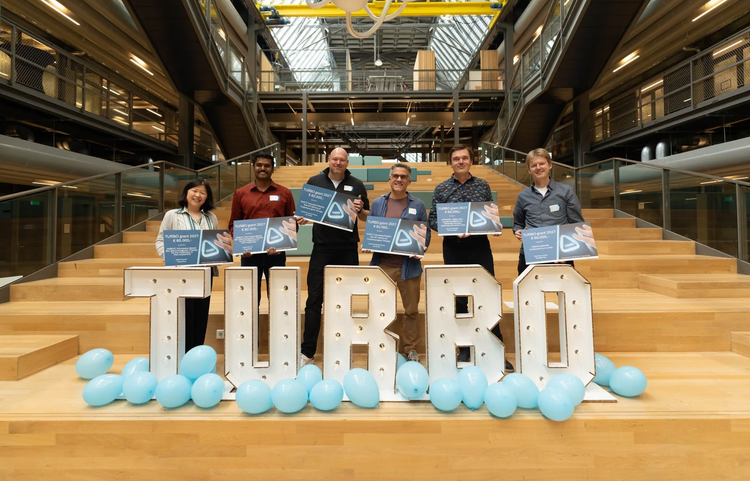
At the end of this HealthTech Nexus day, the TURBO grants were awarded for the tenth time. TURBO, which stands for Twente University RadBoudumc Opportunities, is an important initiative within HealthTech Nexus. TURBO is supporting four new research teams from the University of Twente and Radboudumc with a grant to jointly advance a promising medical-technological idea.
The tenth edition reflected on what TURBO has built up in recent years: a growing connection between clinical expertise from Nijmegen and technological knowledge from Twente, from which new joint research projects are constantly emerging.
Below is an overview of the four projects and their principal applicants.
Dr Jelmer M. Wolterink (University of Twente, EEMCS, Department of Applied Mathematics, Mathematics of Imaging & AI (MIA) group) and Dr Amir H. Sadeghi (Radboudumc, Department of Cardiothoracic Surgery, Advanced Cardiothoracic Surgical Planning and Guidance)
An increasing number of aortic and aortic valve procedures are performed through small incisions in the groin, with physicians advancing thin catheters and prostheses through the blood vessels. These procedures are far less invasive than open-heart surgery but technically demanding. During the procedure, the physician sees only flat X-ray images and must mentally reconstruct the complex 3D anatomy to position the prosthesis or stent precisely. In reality, the aorta moves continuously due to the heartbeat, respiration, and the pressure of the instruments themselves, making navigation through the anatomy difficult. Existing support systems display a pre-acquired 3D scan, but this static image does not move with the anatomy and can diverge from the real situation during the procedure. DYNAMIC is developing a 'digital twin': a patient-specific, dynamic 3D model of the aorta that adapts in real time to these movements during the procedure, giving the physician a continuously accurate view of the anatomy. We expect that this will make procedures more efficient and targeted, with fewer complications and less radiation exposure for both patient and treatment team. In the longer term, the technique could also be applied to other minimally invasive treatments, such as heart valve replacements.
Prof. Séverine Le Gac (University of Twente, EEMCS, Department of Applied Microfluidics for BioEngineering Research) and Dr Matthijs Jore (Radboudumc, Department of Medical Microbiology, research program Vector-borne diseases and zoonoses)
Malaria transmission begins with a mosquito taking a blood meal from an infected person. In the mosquito's stomach, male and female parasites mate, after which the malaria parasite develops into a form that can infect other people. How the fertilisation of malaria parasites in the mosquito stomach takes place is largely unknown; it cannot be studied in vivo and in vitro models are lacking. Here, experts in bioengineering (UT) and malaria parasite biology (Radboudumc) will team up to develop a chip mimicking key elements of the mosquito’s stomach. Specifically, they will iteratively develop chips with increasing level of complexity, to visualise and characterise male parasite motility and attraction to female parasites, providing insight in the first steps of the fertilisation process. This study will provide proof-of-concept for the development of more advanced in vitro models allowing for the first time studying the full fertilisation process in unsurpassed detail. Obtained insights in this fertilisation process will be instrumental for the development of malaria transmission-blocking vaccines and drugs that can eradicate this devastating disease.
Prof. David Fernandez Rivas (University of Twente, TNW, Chemical Engineering Department, Mesoscale Chemical Systems group) and Dr Jos P.H. Smits (Radboudumc, Radboud Institute for Medical Innovation, Dept. of Dermatology, Chronic Inflammatory Diseases (CID) research program)
Inherited skin diseases are caused by defects in genes essential for maintaining healthy skin. Patients suffer from dry, scaly skin, sometimes accompanied by painful fissures, blistering, and increased risk of infections. For most of these disorders, no treatments currently available address the underlying cause of disease.
Gene therapy based on messenger RNA (mRNA) offers a promising strategy to temporarily replace missing or defective proteins. However, a major challenge is delivering these therapies to the correct layer of the skin. Existing approaches often fail to reach the target layer efficiently or require repeated needle-based injections, causing pain and additional skin damage.
In this project (INJECT), researchers from University of Twente and Radboudumc combine their expertise to adapt an innovative needle-free injection technology (“BuBble Gun”) for delivery of therapeutic mRNA into the skin. This technology uses microscopic liquid jets to precisely deliver medicines to a controlled depth. We will investigate how to deliver mRNA safely and efficiently to the correct layers of the epidermis and whether this leads to restoration of skin barrier function in advanced laboratory skin disease models. Successful completion of the project will provide an important step towards new treatments for inherited – and possibly other – skin disorders.
Dr Sujith Raman (University of Twente, Faculty of EEMCS, Radio Systems group) and Dr Fang Yang (Radboudumc, Department of Dentistry, Regenerative Biomaterials group -Orofacial health)
Dental implants are highly successful, but up to 19% of patients develop peri-implantitis—a severe infection where mouth bacteria form a protective "slime layer" (biofilm) on the implant surface, causing painful jawbone loss and eventually implant failure. Current treatments are limited to mechanical scraping of the implant surface combined with antibiotics, which fails up to 55% of the time because standard cleaning tools cannot reach bacteria hiding within the implant's microscopic crevices.
This 1-year project tests a novel, non-antibiotic solution: targeted low-energy microwave therapy. Instead of using damaging heat, specific microwave frequencies generate unique electrical forces designed to safely disrupt biofilms while keeping healthy dental cells intact.
We will build a controlled laboratory testing system to find the exact safe settings for this technology. We will use cell culture to identify tissue safety boundaries, while validating bacterial killing in a human bone block model inserted with dental implants carrying laboratory-grown biofilms. This feasibility study will provide the definitive proof-of-concept needed to secure a larger (inter)national grant to design a safe, handheld device for dentists.
The TURBO program (Twente University Radboudumc Opportunities) is part of HealthTech Nexus, the strategic partnership between Radboudumc and the University of Twente at the intersection of medical technology and health.
Since its inception in 2017, four joint research teams from the University of Twente and Radboudumc have received a TURBO grant of € 80,000 each year. With this start-up funding, they can further develop an innovative medical-technological idea and work towards external follow-up funding, for example through national or European funds.
The 2027 anniversary edition brings the total to 40 awarded TURBO grants. More information about the TURBO programme can be found on the websites of the University of Twente (TechMed Centre) and Radboudumc.


