ITC faculty
This image presents a striking aerial view of a circular urban roundabout at dusk, with roads radiating outward and surrounded by a dense cityscape.

Urban futures

Transforming urban challenges into opportunities

Geo-information technologies provide essential tools for understanding and managing the complex socio-spatial dynamics of urban development. By leveraging GIS, remote sensing, digital planning tools, AI, and Digital Twin models, we support stakeholders in designing targeted interventions that promote long-term urban sustainability, climate adaptation, and improved quality of life. Our commitment to responsible geo-ethical frameworks ensures that these technologies respect local communities, protect privacy, and follow the ‘Do-No-Harm’ Principle.

Urban areas face complex and dynamic challenges related to demographic movements, climate change, energy transitions, transportation, organisational governance, and inequality. The future of cities is marked by uncertainties and risks that are more extreme than those of the recent past. The challenge lies in making urban planning frameworks adaptable to these dynamic conditions, involving multiple stakeholders effectively, and integrating emerging technologies to enhance resilience and adaptability. At ITC, we develop solutions to challenges in small or large urban areas worldwide using our institutional strengthening approach to make a long-lasting impact that helps cities develop sustainably.

The growing threat

Rapid urbanization is reshaping the global landscape, making cities pivotal hubs for innovation, economic growth, and sustainable development. By 2050, cities are expected to house 70% of the world's population, including 3 billion people living in extreme poverty. Urban areas are at the forefront of addressing global challenges such as climate change, resource scarcity, and social inequalities. 

Our approach to Urban Challenges

At ITC, we adopt a transdisciplinary approach in research and education to solve complex urban challenges. We focus on developing Urban Futures Solutions guided by key questions: How can urban planning frameworks be more adaptable? How do interactions between various stakeholders contribute to urban strategies? How can cities integrate emerging technologies to enhance resilience and adaptability? By applying geo-information technologies like remote sensing, hazard and vulnerability mapping, participatory planning approaches, modelling, and social science-based methods, we formulate targeted and contextualised solutions.
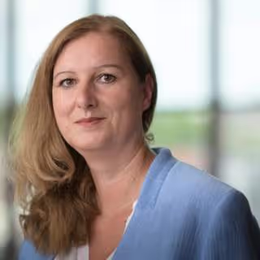
Professor Monika Kuffer Expert in Urban Futures at University of Twente

"With our expertise in Urban Futures, we address the social, environmental, economic, and land tenure challenges in urban areas. Utilizing geospatial technologies, we empower planners and policymakers to visualize and analyze critical urban dynamics. Our people-centric and digitally-informed strategies foster the transition towards safe, healthy, liveable, resilient, and just urban environments. By leveraging spatial data, we support stakeholders in designing targeted interventions that promote long-term sustainability, climate adaptation, and improved quality of life, with a focus on including marginalized groups at the heart of solutions."

Professor Monika Kuffer Expert in Urban Futures at University of Twente

Making real impact

At ITC, our mission is to create real-world impact, primarily in the global south. We advance the field of Urban Futures through innovative research and practical solutions, and are committed to Sustainable Development Goals, including SDG 11 (sustainable cities and communities) and SDG 9. Below are some example projects that we are proud to work on. You can also check our Major Project Database for more urban futures projects at ITC. 

IDEAtlas

The primary objective of IDEAtlas, an ESA funded project, is to develop, implement, validate and showcase advanced AI-based methods to automatically map and characterize the spatial extent of slums from Earth Observation (EO) data. This will support national and local governments as well as the civil society to monitor SDG progress.

Read more
INECIS

Studies on the contribution of urban kampungs to city economies are scarce. INECIS aims to fill this gap by analyzing the relationship between informal economies in kampungs and formal creative industry strategies in Indonesia. The project involves partners from Indonesia and the Netherlands, focusing on integrating informal economic activities into formal strategies and assessing their impact on urban development. The goal is to rethink government-led strategies and their effects on socio-economic characteristics, land, and tenure security in urban kampungs, involving diverse stakeholders in the process.

Show more
BReUCom

Climate change in India increases natural hazards and sea level rise, affecting marginalized urban settlements. The BReUCom project addresses these challenges by developing and piloting Professional Development Programs (PDPs) for urban resilience. It produces open educational resources, new courses, and PDP modules, implemented by a consortium of international partners.

Show more

DIVE INTO OUR MASTER'S PROGRAMMES

View all programmes

Broaden your knowledge with Geoversity

In addition to our master's programmes, ITC offers a range of online courses through our Geoversity platform. Expand your skills, stay up to date with the latest in technology and innovation, and join a global community of learners. With tailored content designed to match your interests, Geoversity offers a journey of personal growth and discovery.

Start exploring today and make an impact with Geoversity!

ITC's expertise in Urban Futures

Meet some of our experts

Are you interested in collaborating with ITC on Urban Futures? Whether you’re looking to study, partner on a research project, access local expertise, join a course, or simply brainstorm ideas, we’re here to connect with you. Feel free to reach out—your ideas and questions are always welcome! Please contact Monika Kuffer or any other expert we have at ITC on urban challenges.