
TEACHER/SUPERVISOR: Dr. Mohammadreza Farrokhnia
TOPIC
Generative AI is rapidly entering university education, but how is it actually being integrated into courses? Beyond simply allowing or prohibiting tools such as ChatGPT, some educators may use GenAI deliberately for feedback, tutoring, brainstorming, assessment, simulations, or AI-literacy activities. Yet we know much less about how widespread these practices are, how pedagogically grounded they are, and what educators need to improve them!
This internship will map how GenAI is officially embedded across BMS bachelor education: who uses it, for what pedagogical purpose, and how deeply it changes the learning activity. Beyond describing use, the study will examine whether current practices are pedagogically or theoretically grounded, informed by research or local evaluation, and what support course coordinators need to develop them further (Qian, 2025; den Hollander et al., 2026).
ASSIGNMENT
Sampling. Construct a sampling frame of programme-owned/core courses across all five BMS bachelor programmes. Stratify by programme × study year and randomly select about two courses per stratum (approximately 30 courses overall), with proportional adjustment where strata differ substantially. (External minors and electives are excluded)
Data collection. Invite coordinators of the sampled courses to complete a short survey and share formal GenAI-related course materials (e.g., syllabus or Canvas statements, assignments, or learning activities). This combines coordinator self-report with documentary evidence, following recent course-material audit approaches (see BenMessaoud et al., 2026).
Core analysis. Code each formal GenAI integration using the 3D matrix shown in Figure 1: who uses GenAI, for what pedagogical purpose, and the depth of integration. The depth dimension follows the four SAMR levels: Substitution, Augmentation, Modification, and Redefinition.
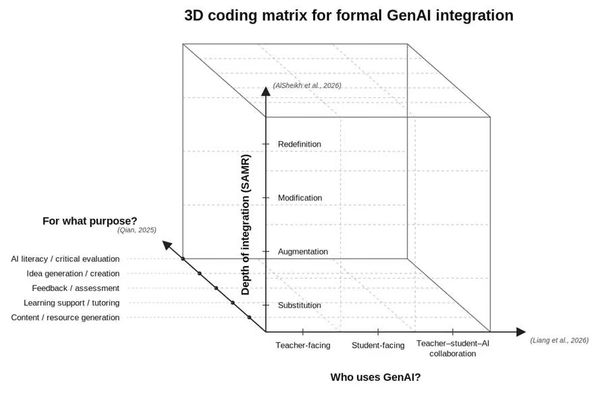
Figure 1. Core coding matrix for mapping formal GenAI integration.
Output. A faculty-level map and taxonomy of GenAI integration, examples of promising practice, gaps in pedagogical and evidence grounding, and actionable recommendations for BMS.
REFERENCES
AlSheikh, M. H., Zaini, R., ALmulhem, M. A., & Ahmad, S. (2026). Mapping artificial intelligence integration in higher education: A systematic review using the FACETS and SAMR frameworks. Frontiers in Education, 11, 1871468. https://doi.org/10.3389/feduc.2026.1871468
BenMessaoud, F., Brewer, R., Buchenot, A., Jones, K., Longtin, K., & Scherzinger, L. (2026). GenAI in course materials: Faculty use and perceptions. Journal of Teaching and Learning with Technology, 14(1), 213–224.
den Hollander, N., Struyf, A., Georgiou, D., & Wong, J. (2026). From perception to policy: Course coordinators’ views on generative artificial intelligence in higher education. International Journal of Educational Management, 40(1–2), 240–255. https://doi.org/10.1108/IJEM-12-2024-0842
Liang, Z., Yang, K., Sha, L., Gašević, D., Yan, L., & Chen, G. (2026). A systematic review of generative AI in education: Empirical insights from a human–AI interaction perspective. British Journal of Educational Technology, 57, 1221–1271. https://doi.org/10.1111/bjet.70055
Qian, Y. (2025). Pedagogical applications of generative AI in higher education: A systematic review of the field. TechTrends, 69, 1105–1120. https://doi.org/10.1007/s11528-025-01100-1