
Interview with Teun Metz (BIT’24) by Diana Dalenoord, UT Alumni Officer
Teun actually chose to study Business Information Technology (BIT) by chance. As a Year 4 VWO student, he initially wanted to study Creative Technology (CreaTe) and applied for a taster day. When that did not work out, he decided to take a look at BIT. It turned out to be a perfect match. During the taster day, he got a good impression of the programme. He even helped during a practical class in which students were making a board game. In Year 5 VWO, he returned once more for a taster day. “I wanted to make sure I had made the right choice. And it turned out I had.”
The small-scale nature of the programme appealed to him. There was plenty going on and plenty of contact with fellow students, without it becoming overwhelming. Moreover, Teun soon realised that BIT offered good prospects for his future. After his bachelor’s, he therefore decided to continue with the master’s in Business Information Technology.
During his master’s, Teun became increasingly interested in ICT management. This is where the technical and organisational sides of IT come together. An important tool in this is the Business Model Canvas, also known within BIT as the ‘holy grail’. This model provides a clear overview of how an organisation creates, delivers and retains value.
But in practice, it is about much more than a nice model on paper. Suppose a company manufactures tables. It needs steel, tabletops, and screws, but also systems to track stock, purchasing, and costs. The next question is which system best fits the organisation, where it will run, who will manage it and how different departments will work with it. Every choice has consequences.
According to Teun, this is precisely where the strength of a BIT graduate lies. You look at the entire process and bring the relevant parties together before important decisions are made. After all, a system can function perfectly from a technical perspective, yet still cause problems if different departments have different interests or expectations.
For his master’s, Teun consciously chose the Enterprise Architecture & ICT Management specialisation. The first module was quite technical and demanded a lot from him.
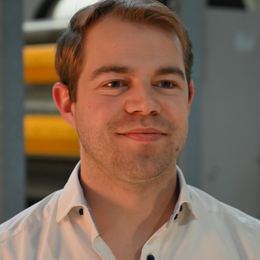
The combination of technology, business and student life made the programme worthwhile for him. He was also able to put his knowledge into practice during his studies. Alongside his degree, he worked at Mobina, where he gained experience with real assignments and organisations. This gave him an early insight into what to expect after graduation.
During his studies, he also developed skills that he still uses every day: working in teams, convincing others of an approach, writing reports, presenting, programming and analysing technical challenges. Not everything comes equally naturally to him, but it is precisely this combination that makes him broadly employable.
After graduating, Teun briefly explored other opportunities, but in reality his next step was already waiting for him. Mobina had interesting assignments lined up, he knew the team, and knew what to expect. He therefore stayed with the company and started working as a Management & IT consultant immediately after graduating.
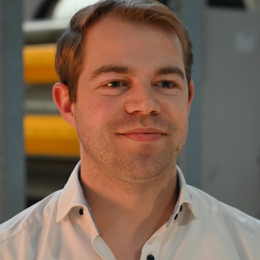
In his work, he is supported by senior consultants and colleagues within Business & IT, operations and management. His team consists of people with diverse backgrounds, from Computer Science and BIT to Civil Engineering and experienced consultants from the former Big Four.
Students also regularly visit the office. Mobina does not have fixed internship positions, but sometimes offers students a part-time job when there is a suitable assignment. Teun knows from his own experience how valuable this can be. He also occasionally supervises students during their BIT-INC projects. In this way, he remains connected to the programme.
Artificial intelligence now also plays a role within Mobina. According to Teun, AI is a valuable tool for working more efficiently and specifically, but human expertise remains essential. Employees check the results and ultimately remain in control.
For him, this fits well with the way he learned to work during BIT: using technology to solve problems, while always considering the context, the people who will work with it and the ultimate goal.
Although Teun has now been working for a few years, he looks back on his student days with great pleasure. He lived in student accommodation, became active in the study association Inter-Actief, took up rowing at Euros and joined the HGB fraternity. Above all, the friends he made during his studies are still part of his life.
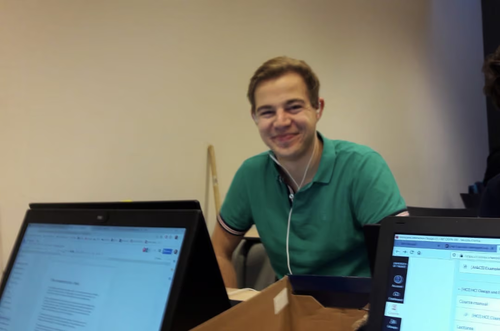
Photo: Teun as a BIT student


