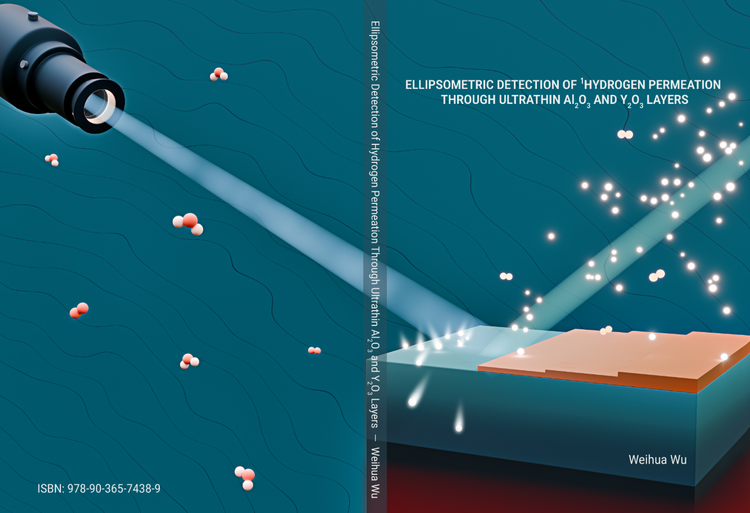
Ellipsometric Detection of Hydrogen Permeation Through Ultrathin Al2O3 and Y2O3 Layers
Weihua Wu is a PhD student in the Department of Integrated Devices and Systems. (Co)Promotors are prof.dr. J. Schmitz and dr. A.Y. Kovalgin from the Faculty of Electrical Engineering, Mathematics and Computer Science, prof.dr. M.D. Ackermann and dr.ir. R.W.E. van de Kruijs from the Faculty of Science & Technology.

Hydrogen is essential in a range of advanced technologies, including extreme ultraviolet (EUV) lithography used for manufacturing next-generation computer chips and future fusion energy systems. However, highly reactive hydrogen species can penetrate materials and coatings, leading to unwanted chemical and structural changes of critical components. Developing ultrathin protective coatings that can effectively block hydrogen transport is therefore an important scientific and technological challenge.
This work investigates how atomic hydrogen permeates through ultrathin oxide films, with a particular focus on aluminum oxide (Al₂O₃) and yttrium oxide (Y₂O₃). Because hydrogen is difficult to observe directly inside thin films, a non-destructive optical method based on spectroscopic ellipsometry was developed to monitor hydrogen transport in real time. By combining thin-film fabrication, optical characterization, structural analysis, and hydrogen quantification, the work reveals how hydrogen interacts with nanometer-scale oxide barriers under conditions relevant to industrial applications.
The research shows that atomic-layer-deposited Al₂O₃ is an effective hydrogen permeation barrier even at thicknesses of only a few nanometers. Increasing the Al₂O₃ thickness significantly retards the permeation of hydrogen. Furthermore, the hydrogen diffusion in Al₂O₃ is suggested to follow a thermally activated mechanism, allowing key diffusion parameters to be determined. In parallel, the deposition and properties of Y₂O₃ thin films were investigated to provide more insights into the growth behaviour before the potential use as hydrogen barriers. Overall, this work introduces a practical optical methodology for hydrogen barrier performance evaluation and advances our fundamental understanding of hydrogen permeation through ultrathin coatings. The findings contribute to the development of more durable protective materials for semiconductor manufacturing and advanced energy technologies.


