Engineering pei Hydrogel particle sorbents for CO2 capture
Yiwei Long is a PhD student in the Department of Fluid Mechanics for Functional Materials. (Co)Promotors are dr.ir. C.W. Visser, prof.Dr.-Ing. W. Rohlfs and dr. J. Jiang from the Faculty of Engineering Technology and prof.dr.ir. D.W.F. Brilman from the Faculty of Science & Technology.

Capturing CO2 may sound simple: bring the gas into contact with a material that binds it. In practice, however, an effective capture material must do much more. It must absorb CO2 rapidly, release it again without excessive energy use, remain stable over repeated cycles, and function under the changing conditions found in real processes.
This thesis explores amine-based hydrogels as a new platform for CO2 capture. Hydrogels are soft, water-rich polymer networks, familiar from products such as contact lenses and wound dressings. When equipped with amine groups, they can interact strongly and selectively with CO2. Their unusual combination of reactive chemistry, internal water and adaptable structure offers promising opportunities, but also raises important questions: How does CO2 travel through and react inside a hydrogel? How do water content, particle dimensions, the connections between polymer chains and internal pore structure influence capture performance? Can these soft and sticky materials be shaped into practical sorbents? And can the material itself tell us how much CO2 it has captured?
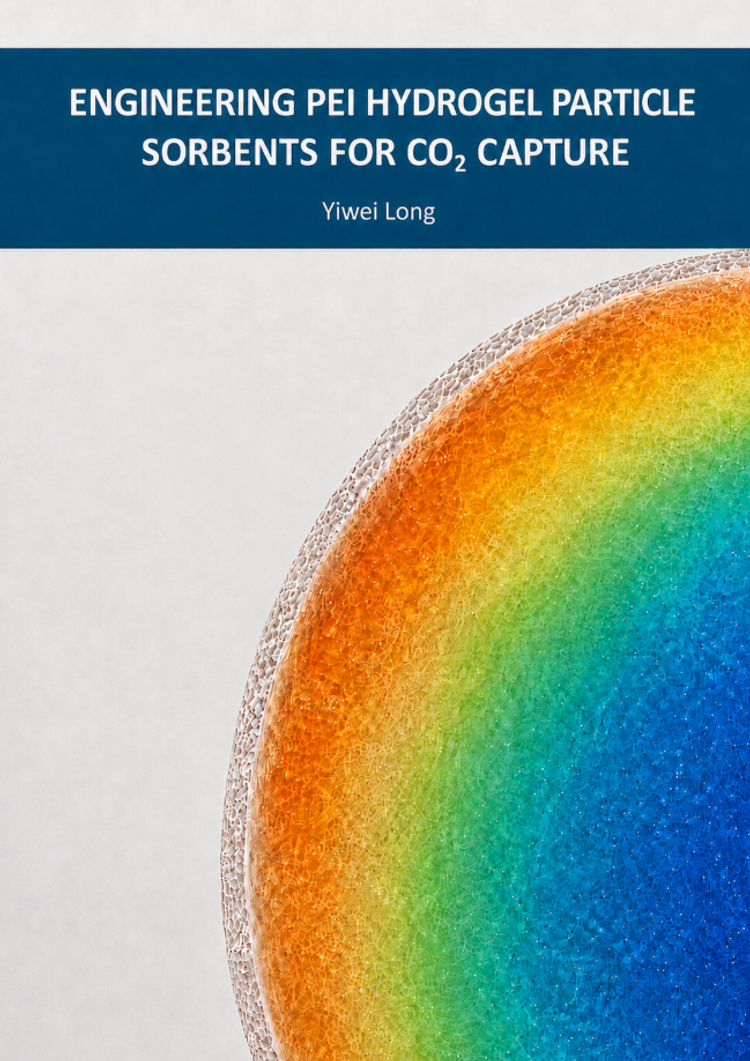
By combining material synthesis, experiments and mathematical modelling, this thesis addresses these questions across multiple length scales, from reactions and transport within individual particles to behaviour during repeated operation. The work shows that CO2 capture cannot be optimized through chemistry alone: reaction, water, internal transport and material structure must be considered together. It also introduces hydrogel sorbents that change colour as they absorb and release CO2, making a normally invisible process directly observable.
Ultimately, this research provides a framework for designing CO2 sorbents that are not only effective, but also structurally robust, regenerable and easier to understand and monitor.


