
The University of Twente is awarding four honorary doctorates to mark its 65th anniversary. They go to biomedical materials scientist Molly Stevens, World Bank economist Klaus Deininger, Marjolein Demmers, director of the Dutch environmental organisation Natuur & Milieu, and ASML's former president and chief technology officer Martin van den Brink. Each of them represents one of the four areas where UT wants to make an impact: health, safety, climate and chip technology. The doctorates will be conferred on Friday 27 November, during the Dies Natalis.
Every five years the University of Twente awards honorary doctorates to people who have rendered outstanding service to science and society. For this anniversary the choice fell on four people who each show, in a different field, what knowledge is worth in practice: in the clinic, in national land policy, at the political negotiating table and in high-tech industry. Honorary doctors are entitled to use the title doctor honoris causa (dr.h.c.). UT regards them as important ambassadors.
The anniversary year has courage as its theme. UT describes that as taking the road that is necessary rather than the road that is easiest. It can be recognised in all four honorary doctorates. Stevens works where disciplines meet that do not speak each other’s language. Deininger began registering land in countries where land is politically sensitive. Demmers seeks out the table where the friction is. And under Van den Brink, ASML invested billions in a technology that did not yet exist.
Photo credit: David Vintiner
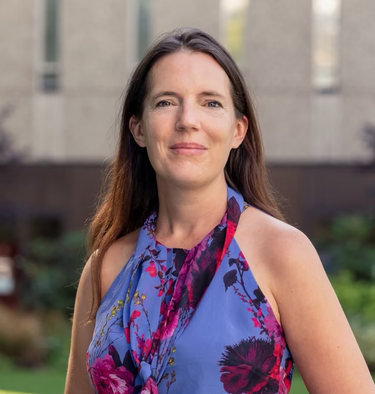 Molly Stevens is John Black Professor of Bionanoscience at the University of Oxford and deputy director of the Kavli Institute for Nanoscience Discovery. Before that she built up her research group at Imperial College London. Her work sits where materials science, medicine, nanotechnology and bioengineering meet. She designs materials that prompt the body to repair itself, and sensors that make disease visible sooner.
One example is the degradable silicon nanoneedles her group co-developed. They deliver genetic material straight into cells, to set repair in motion and encourage the growth of new blood vessels. That is the kind of step from laboratory to patient that UT’s TechMed Centre is aiming for as well.
"Molly shows how bringing together expertise from different fields can lead to innovations that make a difference for patients", says honorary supervisor Maroeska Rovers. In 2013 Stevens gave the Bergveld Lecture in Twente at the invitation of the BIOS group, the annual lecture named after professor emeritus Piet Bergveld. What strikes her honorary supervisors is that despite a large research group and a full diary, she keeps seeing the person behind the researcher.
Stevens was elected a Fellow of the Royal Society in 2020, received the Novo Nordisk Prize in 2023 and was appointed Dame Commander of the Order of the British Empire in 2024. She studied pharmacy at the University of Bath and took her PhD at the University of Nottingham.
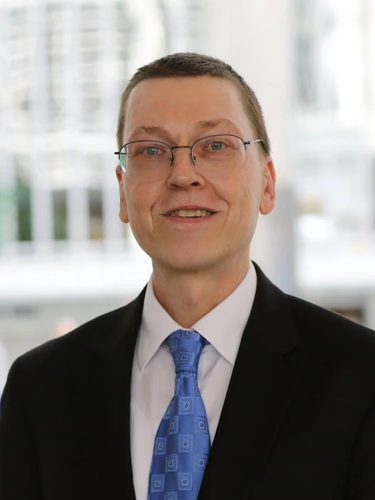
Klaus Deininger is a lead economist in the research department of the World Bank. He studies what changes in a country once it is recorded who may use which land. Between 1999 and 2019 he organised the World Bank’s annual Land and Poverty Conference, for a long time the leading international forum in this field.
Well-registered land is not an administrative detail. It can serve as collateral for a loan. It allows a government to respond faster after a disaster. And it removes a common source of conflict, because uncertainty about access to land often plays a part in how conflicts arise and how they are settled. Researchers call this tenure security. By that they mean people’s confidence that in five years’ time they will still be on the same land.
Deininger is an economist by training and saw early on what geoinformation could contribute. He has worked in Ethiopia, India, Ukraine, Malawi and Moldova, among other countries. His findings end up both in World Bank reports and in scientific journals. That covers all three forms of impact named in UT’s research strategy: academic, economic and societal.
"It is high tech, human touch", says honorary supervisor Jaap Zevenbergen. "You have to be good at surveying land, but you also have to know what a registration does to people’s behaviour." Zevenbergen first met Deininger in Ethiopia in 2005, during an evaluation of a new and simpler way of registering land, in which Deininger helped improve the valuation of land. What has stayed with him since is the stamina. Where the rest of the party wants to sit down to eat, Deininger wants to finish one more thing first.
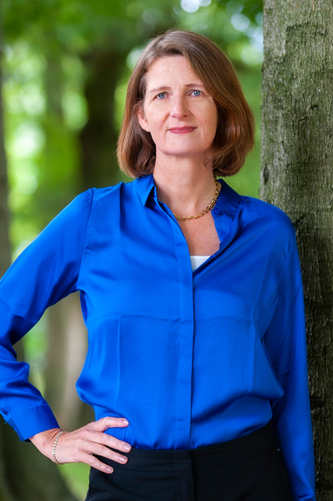 Marjolein Demmers has been director of Natuur & Milieu since November 2017. She has spent more than 30 years working where climate, the environment, business and policy meet. She studied industrial design engineering at Delft University of Technology, took an MBA at INSEAD and started out as a specialist in ecodesign and life-cycle assessment. She worked as a researcher on the ecodesign programme in the Netherlands and in Victoria, Australia, at RMIT's Centre for Design. She went on to work at McKinsey, Essent and Royal HaskoningDHV, and led De Groene Zaak, an association of companies that set out to make the economy more sustainable.
Demmers focuses on the transition of the systems that cause climate change and biodiversity loss, and seeks out the table where the strategic decisions are made. Rules and policy on clean water, sustainable agriculture and industrial transitions are shaped in part by Natuur & Milieu. The fact that Demmers and her closest colleagues are regularly invited to talk to ministers and members of parliament says something about the weight of that contribution. Together with the construction federation Bouwend Nederland, the employers' organisation VNO-NCW and the conservation organisation Natuurmonumenten, Natuur & Milieu has presented a plan for cutting nitrogen emissions several times in recent years, and again this year during the coalition formation talks.
"She is very clear about what needs to happen, and she always brings several perspectives into it", says honorary supervisor Cheryl de Boer. "That is why she brings a lot of people with her, and meets less resistance."
That way of working fits the newly established UT Climate Centre, where the question is how knowledge of climate, water, flood safety, nature and agriculture can be put to use so that something actually changes. Demmers does it from within a civil-society organisation. Together with honorary supervisor Gerard van der Steenhoven she sits on the steering group of Klimaatonderzoek Initiatief Nederland, the Dutch climate research initiative, of which the UT Climate Centre is one of the hubs.
When they first met, De Boer discovered that they had followed a comparable path. Both began with a degree in understanding systems and improving them, and both came to the conclusion that placing things in a broader perspective creates more possibilities. The day before the ceremony they are jointly organising a meeting on how knowledge institutions and civil-society organisations can strengthen each other in transitions.
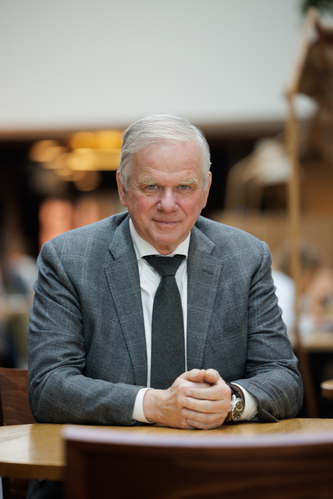 Martin van den Brink studied applied physics at the University of Twente and spent almost his entire career at ASML, where he rose to become president and chief technology officer. He stepped down in April 2024 and still advises the company. He devised the mask-to-wafer alignment that ASML uses to this day, and played a central part in the development of EUV lithography.
In EUV, a machine projects chip patterns using light with a wavelength of 13.5 nanometres. That calls for a light source, mirrors that collect the light, a photoresist that reacts to it, and extreme precision to move mask and wafer in step, all four tuned to one another. A good light source is no help if you cannot control it. And that is only the start: not a single machine but an entire production chain, with software that runs reliably day and night, customers and suppliers moving with you, and an investment running into billions over decades. High-NA EUV followed, with a larger numerical aperture. The light reaches the wafer at a wider angle, which makes it possible to project finer patterns.
"He did not do it on his own, but he was the linchpin", says honorary supervisor Maarten Bonnema. "He brought the right people together and pushed them. At ASML they call that challenging."
The three honorary supervisors come from three faculties, and that is no coincidence. Bonnema stands for systems engineering, Marcelo Ackermann for the optics and the mirrors, Marieke Huisman for software and reliability. Without mirrors, the machine does nothing. Without software, a customer cannot work with it. Without systems engineering, it stays a heap of parts instead of a machine worth having.
The Dies Natalis takes place on Friday 27 November in the Waaier building on campus and is the high point of the anniversary year, in which UT celebrates 65 years. The full programme is on UT’s anniversary page. On Tuesday 29 September, Martin van den Brink is already a guest of Studium Generale, in the Vrijhof amphitheatre.


