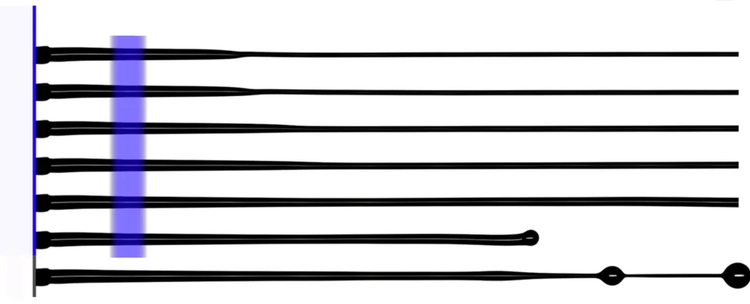
From spiders spinning their webs to the manufacturing of textiles, the formation of fibers from liquids plays an important role in both nature and industry. Yet accurately predicting the properties of such fibers remains a challenge. The fiber is often much thinner than the nozzle from which a polymer or solution is extruded. Factors such as temperature, flow conditions, and chemical reactions ultimately determine a fiber’s thickness and strength.
In a new experimental study, researcher Jan Siemen Smink (Faculty of Engineering Technology) demonstrates the physical processes involved in the formation of fibers from liquids. To investigate this phenomenon, he developed an experimental setup in which gravity continuously stretches a jet of highly reactive liquid resin. Ultraviolet (UV) light is then used to solidify the liquid at a precisely controlled moment, transforming it into a thin fiber.
Using this approach, Smink and his co-researchers were able to study in detail how factors such as UV light intensity, gravity, inertia, and capillary forces influence both the rate at which the liquid solidifies and the properties of the resulting fiber.
Video above: A gravity-stretched jet of reactive liquid is illuminated with ultraviolet (UV) light. The movie has been rotated so that gravity acts from left to right. As soon as the UV light is switched on, the liquid transforms into a solid. The video clearly shows that the jet diameter does not evolve in a straightforward or easily predictable way.
Video above: Two liquid jets are shown, with the jet on the right illuminated by UV light. To demonstrate that this jet has indeed solidified, both jets are collected on a plate. Only the illuminated jet retains its shape, confirming that the UV light has transformed the liquid into a solid material.
The study “Fast Solidification of a Gravity-Stretched Liquid Jet” was published on 2 October in Physical Review Letters. The article can be accessed via DOI: https://doi.org/10.1103/yh2j-b3wq.
The paper was selected as both an Editors’ Suggestion and Featured in Physics, two distinctions awarded to particularly noteworthy publications in Physical Review Letters. An accompanying article in Physics Magazine (published by the American Physical Society and aimed at a broad audience) is available at: https://physics.aps.org/articles/v19/137.


